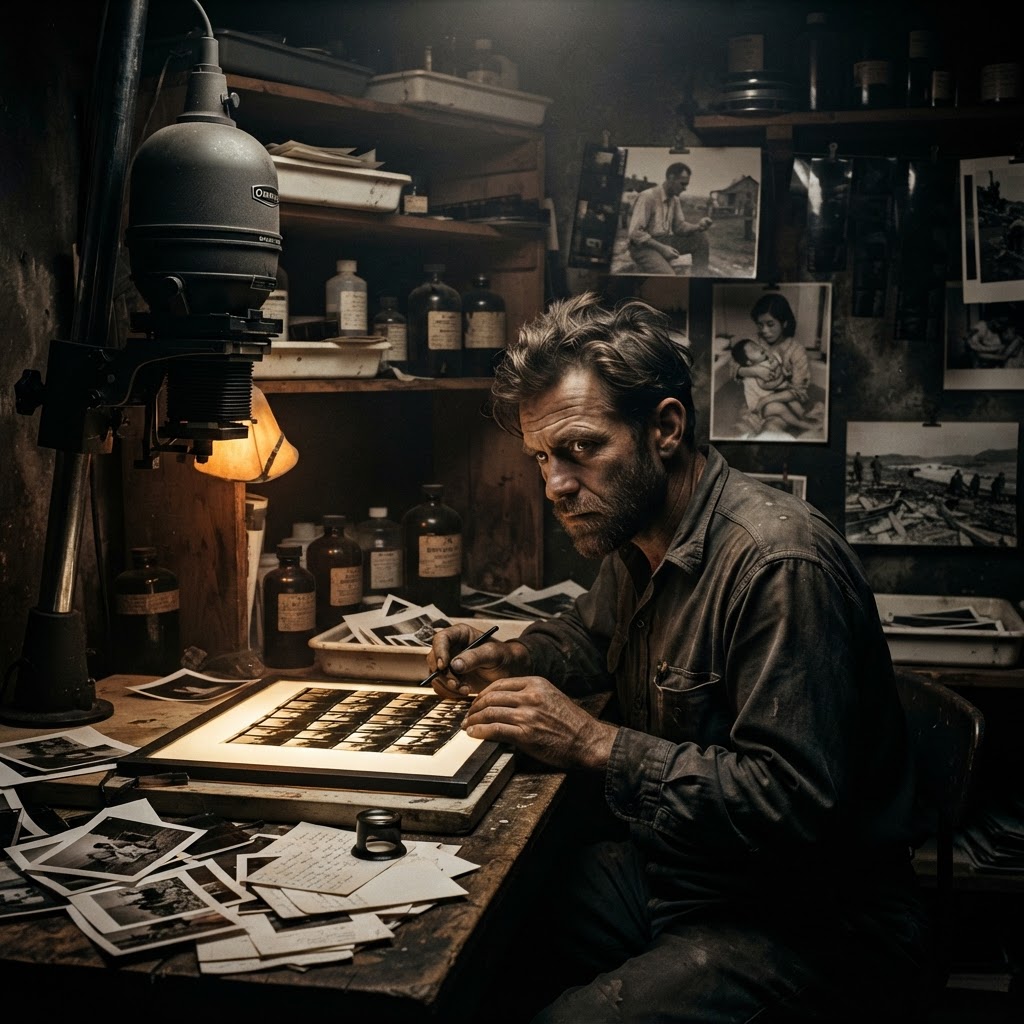
Tina Modotti: The Revolutionary Lens and the Poetry of Resistance
The Rebel in the Darkroom
In the pantheon of 20th-century photography, few lives are as inextricably linked to the fervor of political upheaval and artistic transformation as that of Tina Modotti. Born in Udine, Italy, in 1896, Modotti was not merely a documentarian; she was a bridge between the avant-garde formalism of Europe and the raw, revolutionary pulse of post-revolutionary Mexico. Her journey from the silent film studios of Hollywood to the gritty streets of Mexico City remains one of the most compelling narratives in photographic history.
Modotti arrived in Mexico in 1923, accompanied by the legendary photographer Edward Weston. While she initially served as his muse and apprentice, she quickly outgrew the role of subject to become a formidable master of the medium in her own right. Where Weston obsessed over the curve of a pepper or the texture of a seashell, Modotti looked deeper into the social fabric, finding beauty in the calloused hands of the proletariat and the quiet geometry of industrial tools.
From Formalism to the People
Modotti’s signature style underwent a profound evolution. Her early work, heavily influenced by Weston’s 'straight photography,' focused on the purity of light and shadow on static objects. Yet, as she became increasingly involved in the radical political movements of the 1920s, her focus shifted. She began to treat the camera as a weapon of conscience. Her images of Mexican muralists, laborers, and impoverished street children were imbued with a sense of dignity that was entirely absent from the colonial gaze of her contemporaries.
The camera is not a luxury, but a necessity for those who dare to document the truth of a changing world.
Her technical approach was defined by a stark, uncompromising clarity. She utilized the full tonal range of the black-and-white medium to elevate humble subjects—a bandolier, a sickle, a loaf of bread—into symbols of resistance. She proved that the medium of photography could be simultaneously high art and a vital tool for political mobilization.
Iconic Works and the Weight of History
Among her most celebrated images is 'Bandolier, Corn, and Sickle' (1927). In this composition, the objects are arranged with the precision of a still life, yet they resonate with the power of a revolutionary manifesto. The interplay of textures—the cold metal of the ammunition against the organic, rough grain of the corn—encapsulates the tension of the Mexican agrarian struggle. This image remains a masterclass in symbolic photography, demonstrating how the arrangement of inanimate objects can articulate complex human ideologies.
Modotti’s life was fraught with challenge. Her commitment to the Communist Party and her vocal opposition to fascism led to her deportation from Mexico in 1930. She traveled through Europe, eventually finding herself on the front lines of the Spanish Civil War. Her camera became her lifeline, documenting the trauma and the fleeting moments of humanity amidst the wreckage of conflict. She eventually returned to Mexico, living her final years in relative obscurity, far removed from the artistic circles she had once helped define.
A Lasting Impact
Why does Tina Modotti matter today? Because she reminds us that the photograph is never neutral. She broke the mold of the 'detached artist,' proving that a photographer's gaze is shaped by their values, their courage, and their empathy. Her work survives as a testament to the idea that photography can be both intellectually rigorous and deeply human.
In an age where imagery is often fleeting and detached from context, Modotti’s dedication to the 'decisive moment'—not just as a matter of timing, but as a matter of conviction—stands as a beacon for modern photographers. She did not merely observe the world; she participated in its transformation, proving that the lens, when held by a steady and principled hand, can indeed change the way we see history.
- Focus: Mastery of natural light and minimalist composition.
- Style: Transitioned from pure aestheticism to potent social realism.
- Legacy: A pioneer in the fusion of political activism and fine art photography.
- Philosophy: The belief that art is an instrument for social change.
Tina Modotti passed away in 1942, but her prints continue to challenge the status quo. She remains a vital figure for anyone interested in the ethical dimensions of the image, offering a path for those who wish to tell the truth through the play of light and shadow.