The Stereoscope: How Victorian Britain Found Depth in a Flat World
The Illusion of Presence
In the mid-19th century, the photograph was a marvel, but it remained firmly tethered to the flat surface of paper. Yet, there was a quiet, obsessive pursuit among scientists and artists alike to bridge the gap between a two-dimensional representation and the lived experience of human vision. Enter the stereoscope—an instrument that did not merely capture light, but synthesized the very mechanics of human binocular vision to create an optical illusion so profound it felt like magic.
The Science of Two Eyes
The secret of the stereoscope lies in the fundamental nature of our sight. Because our eyes are set approximately two and a half inches apart, they capture two slightly different perspectives of the same scene. The brain performs an incredible feat of computation, stitching these disparate images together to create depth. Sir Charles Wheatstone, working in the 1830s, discovered that if you could present these two slightly varied images to each eye independently, the brain would perceive a single, unified 3D object.
The stereoscope was not just a scientific curiosity; it was the Victorian equivalent of virtual reality, bringing the world into the parlor in a way that static prints never could.
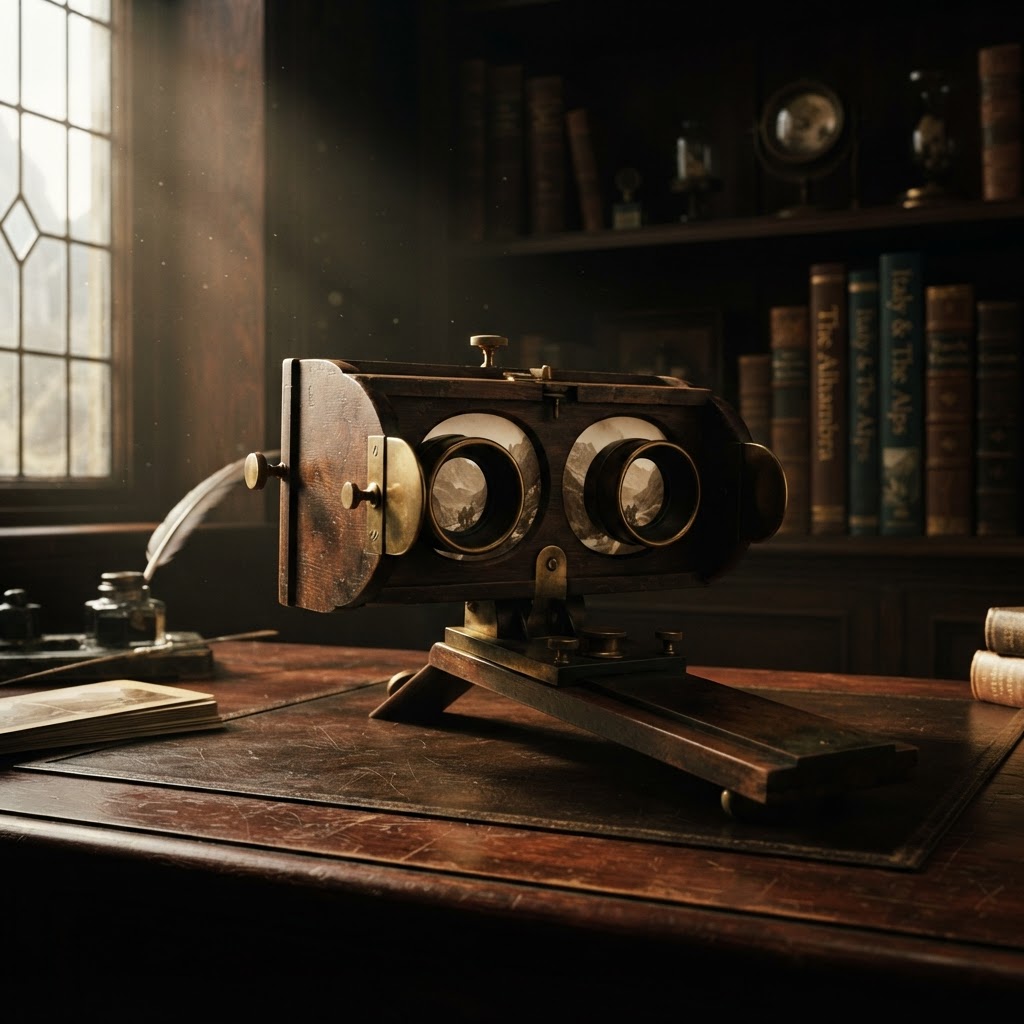
By the time Sir David Brewster refined the design in the late 1840s—creating a portable, binocular viewer using lenses rather than mirrors—the stereoscope became the must-have parlor item for the British middle class. It allowed the armchair traveler to witness the ruins of Egypt, the jagged peaks of the Alps, or the bustling streets of London with an intensity that felt truly physical.
A Catalyst for Visual Culture
The impact of stereoscopic photography on the visual culture of the era cannot be overstated. It forced photographers to consider spatial geometry in a way they never had before. To create a successful stereocard, one had to position the camera at two distinct points, mimicking the distance between human eyes. This necessitated a new level of precision in equipment and composition. It gave birth to a massive, global industry of 'view manufacturers' who fanned out across the globe, capturing the world for a public hungry for depth.
- Tactile Realism: Viewers felt they could reach into the image, creating an emotional intimacy with distant subjects.
- Educational Expansion: The stereoscope brought the wonders of geography and architecture to schools, predating the modern documentary.
- Commercial Proliferation: Millions of cards were sold, marking one of the earliest instances of a mass-market photographic craze.
The Legacy of the Third Dimension
The stereoscope eventually waned in popularity as the novelty settled and motion pictures took center stage in the early 20th century. Yet, its DNA remains embedded in every iteration of 3D technology that followed, from the View-Master reels of the mid-century to the VR headsets of our contemporary era. As photographers, we should look back at the stereoscope not as a primitive toy, but as a testament to our enduring desire to defy the limitations of our medium. We are always seeking to capture more than just light; we are seeking to capture the weight and space of reality itself. In the quiet, gold-flecked corners of a museum gallery, peering through an old wooden viewer, you can still catch a glimpse of that Victorian wonder—a reminder that photography has always been, at its heart, an attempt to make the flat image feel as deep as the soul.