The Glass Master: Eadweard Muybridge and the Birth of Motion
The Bet That Stopped Time
In the spring of 1872, the rolling plains of California became the site of a profound philosophical and optical debate. Leland Stanford, the industrialist and former governor, engaged in a heated argument: at the height of a gallop, did a horse have all four hooves off the ground simultaneously? To the human eye, the motion was a blur—a rhythmic pulse of dirt and muscle that defied precise analysis. It was this curiosity that brought together the industrial ambition of Stanford and the mechanical genius of an English-born photographer named Eadweard Muybridge.
The Anatomy of a Gallop
Muybridge was not merely a landscape photographer; he was a master of the wet-plate collodion process, accustomed to the grueling patience required to capture the rugged beauty of Yosemite. However, the task of capturing a horse in motion presented an entirely new, insurmountable challenge: shutter speed. In the 1870s, the chemical limitations of photographic emulsions required long exposures, rendering fast-moving objects as mere ghostly smears. Muybridge realized that to answer Stanford's question, he would have to invent a new language of photography.
The eye is a deceptive witness; it captures the result of motion, but fails to grasp the mechanical truth of the transition.
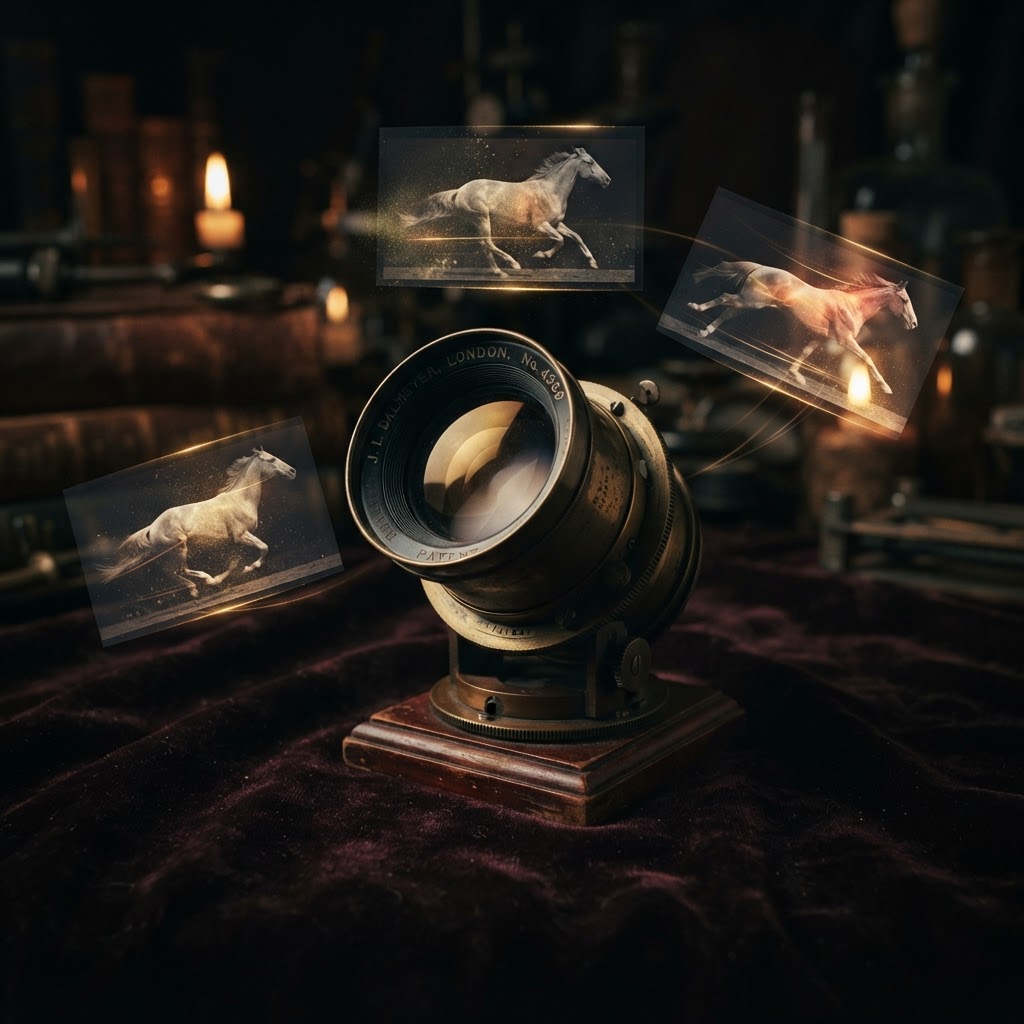
After years of experimentation, Muybridge devised a system of twelve (and later twenty-four) cameras placed in a row along a racetrack. Each shutter was triggered by a fine silk thread broken by the horse's hoof as it sprinted past. This was the birth of chronophotography. When the plates were developed, the world saw something that had previously existed only in the subconscious of the human observer: the horse, indeed, lifted all four hooves at once, suspended in a moment of pure, fleeting grace.
The Legacy of the Zoopraxiscope
Muybridge did not stop at static proof. He sought to reassemble these frames into a coherent narrative of movement. He developed the zoopraxiscope, a device that projected these sequential images in rapid succession, creating the illusion of real-time motion. This was the direct ancestor of the motion picture camera. His work, Animal Locomotion, transformed biology and art alike:
- Scientific Precision: Painters realized they had been depicting galloping horses incorrectly for centuries, leading to a sudden shift in the realism of equestrian art.
- Analytical Vision: Scientists began to study the biomechanics of humans and animals in ways previously thought impossible.
- The Cinematic Foundation: The realization that persistence of vision could be exploited to create narrative film changed global culture forever.
At Photography in the Raw, we often speak about the "decisive moment," but Muybridge reminds us that the decisive moment is not always a singular point in time—it is often a sequence of events, a flow of energy that requires us to understand the physics of our medium. Muybridge taught us that the camera is not just a device for preserving beauty; it is a tool for uncovering the truths that move too quickly for the human heart to comprehend.
As you step behind your own lens, consider the mechanics of your subjects. Are you chasing the stillness, or are you looking for the kinetic thread that connects one moment to the next? Muybridge’s legacy is a testament to the fact that when we push the boundaries of what our equipment can record, we inevitably expand the boundaries of human knowledge.