The Silent Revolution: The Birth and Brilliance of the Leica I
The Architect of the Miniature
In the early twentieth century, photography was a pursuit of patience and immense physical burden. To capture a moment, one had to haul heavy wooden cameras, tripods, and fragile glass plates into the field. But in 1913, at the Leitz factory in Wetzlar, Germany, a modest engineer named Oscar Barnack was quietly stitching together a different reality. Barnack, who suffered from asthma, grew weary of lugging heavy equipment while trying to photograph the outdoors. His solution was not just a camera; it was a conceptual rupture in how humans interacted with time.
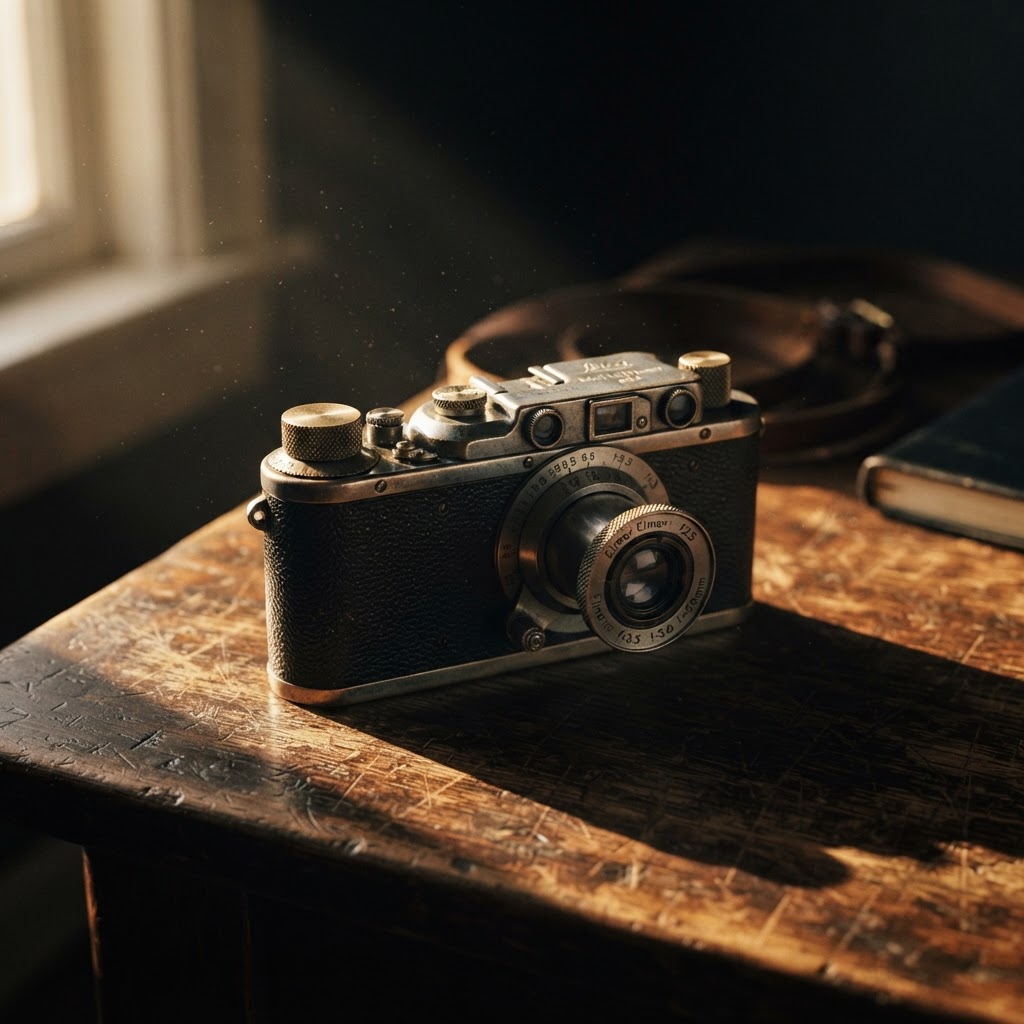
By repurposing 35mm motion picture film for still photography, Barnack created a device that could fit into a coat pocket. The Leica I (the name a portmanteau of Leitz and Camera) was officially launched at the Leipzig Spring Fair in 1925, and with it, the era of street photography was born.
The Freedom of the Candid Lens
The introduction of the Leica I allowed photographers to move through the world with an unprecedented agility. Before this, the long exposures required by plate cameras meant that the subject was often posed, stiff, and performative. The Leica allowed for handheld operation at relatively fast shutter speeds. This technical shift fundamentally altered the visual language of the twentieth century.
The camera became a sketchbook, a pen, and an eye that could blink at the speed of human movement.
Suddenly, the photographer was no longer an architect of static scenes but a hunter of fleeting moments. This was the birth of the 'decisive moment' before the term was even coined. Photographers could now capture the grit, the joy, and the chaotic beauty of life as it unfolded in real-time, away from the sterile confines of the studio.
The Mechanics of a Legend
At the heart of the Leica I was a precision that matched its ambition. The camera utilized a focal-plane shutter and an Elmar 50mm f/3.5 lens, an optic so sharp that it redefined standards for photographic fidelity. The genius of the Leica was in its simplicity. It lacked a built-in rangefinder initially, forcing the photographer to rely on keen estimation, which only heightened the tactile, intuitive connection between the user and the machine.
- Compactness: It liberated the photographer from the tripod.
- Film Economy: The use of 35mm film allowed for rapid-fire sequences that were previously impossible.
- Durability: The precision-engineered metal body set a new benchmark for industrial design.
A Legacy of Unseen Worlds
The impact of the Leica I cannot be overstated. It was the instrument that allowed Henri Cartier-Bresson to haunt the streets of Paris and Robert Frank to document the soul of America. By removing the physical wall between the lens and the subject, Barnack ensured that photography would become the primary record of human experience. At Photography in the Raw, we teach that the gear is merely an extension of the intent. The Leica I serves as the eternal reminder that the most profound technological advancements are those that allow us to become more human, not less. It did not just take pictures; it allowed us to witness the world with a newfound, intimate honesty.