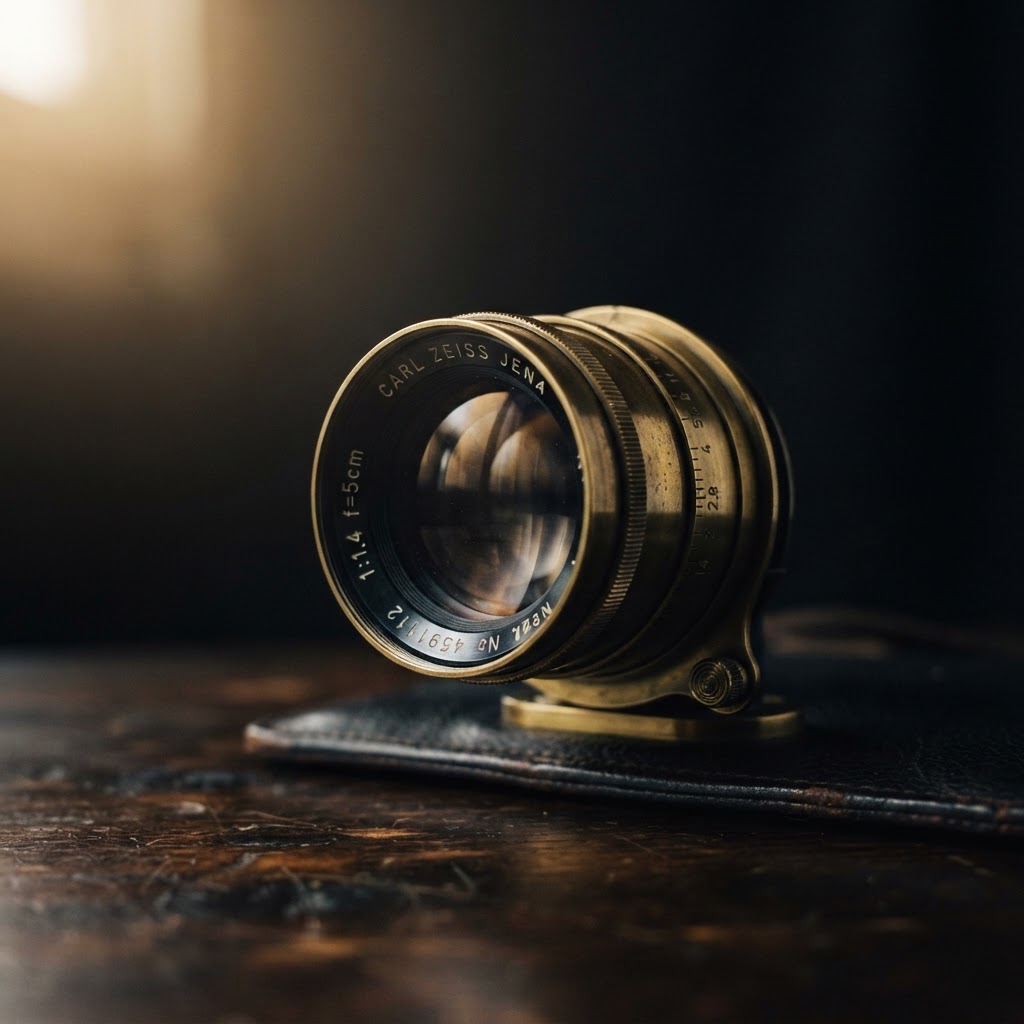
The Mathematical Pulse: Unraveling the History and Science of the F-Stop
The Anatomy of Aperture
In the quiet, light-drenched corners of our studio at Salt Media, we often talk about 'f-stops' as if they were a musical scale. We adjust our aperture rings—or our digital dials—to perform a symphony of light, yet rarely do we pause to consider the etymology of that single, enigmatic letter f. To understand the f-stop is to bridge the gap between the chaotic physics of light and the structured precision of art. It is the gatekeeper of the lens, a mechanical iris that dictates the very breath of a photograph.
The Etymology of Precision
The term 'f-stop' is a shorthand that emerged from the necessity of standardized optical mathematics in the late 19th century. The 'f' stands for focal length, and the value associated with it represents the ratio of the focal length of the lens to the diameter of the entrance pupil. Essentially, the f-stop is a fraction. When we say we are shooting at f/8, we are stating that the aperture diameter is exactly one-eighth of the lens's focal length. This seemingly simple discovery transformed photography from an experimental alchemy into a measurable science.
From Chaos to the Royal Photographic Society
Before the mid-1890s, the world of aperture markings was a chaotic landscape of proprietary systems. Every lens manufacturer had their own scale, rendering the advice of masters almost impossible to replicate across different kits. The turning point arrived when the Royal Photographic Society advocated for a universal system. By anchoring the measurement to the ratio of focal length, they provided photographers with a common language. This transition allowed a photographer in Frederick, Colorado, to interpret the exposure notes of a peer in Paris with total clarity. It was the birth of the 'standard' f-stop scale we use today: f/1, f/1.4, f/2, f/2.8, f/4, f/5.6, f/8, f/11, f/16, and f/22.
The beauty of the f-stop lies in its inverse relationship; the smaller the number, the larger the opening, and the more light the lens drinks in. It is a paradox of optical physics that continues to guide our vision.
The Geometric Progression
Why do these numbers look so strange? Why does the sequence leap from 2 to 2.8 to 4? The answer lies in the geometry of the circle. Because we are dealing with the area of a circular aperture, we must account for the square root of two—approximately 1.414. Each 'full stop' represents a doubling or halving of the light hitting the sensor or film plane. To double the area of a circle, you must increase the diameter by the square root of two. This mathematical necessity is the reason our aperture rings move in those precise, logarithmic intervals.
The Creative Utility of the Stop
Beyond the math, the f-stop is the sculptor of depth. The choice of aperture is the primary tool by which we control the 'depth of field,' or the zone of acceptable sharpness. A wide aperture (f/1.4 or f/2) isolates a subject in a sea of soft, cinematic blur, while a narrow aperture (f/16 or f/22) demands that the landscape remains crisp from the foreground to the distant horizon. When I teach at Photography in the Raw, I emphasize that every click of the aperture ring is an artistic decision, not merely a technical one.
- Wide Apertures (f/1.4 - f/2.8): Used for isolating subjects and softening backgrounds.
- Mid-Range Apertures (f/4 - f/8): Often considered the 'sweet spot' for lens sharpness and versatility.
- Narrow Apertures (f/11 - f/22): Essential for deep focus, though limited by the laws of diffraction.
The Legacy of the Aperture
As we move further into the digital age, the mechanical iris remains a constant. Even as lenses become computerized, the underlying geometry of the f-stop is immutable. It is the language of light, a mathematical shorthand that allows us to interpret reality through glass. When you look through your viewfinder next, remember that you are not just framing a scene; you are performing an act of historical precision that links you to the pioneers who first sought to quantify the infinite nature of light.