Silver Mirrors: Unpacking the Alchemy of the Daguerreotype
The Genesis of a Frozen Reality
In the quiet workshops of 19th-century Paris, Louis-Jacques-Mandé Daguerre achieved what humanity had pursued for centuries: the capture of a fleeting moment upon a permanent substrate. The Daguerreotype is not merely an antique; it is the philosophical cornerstone of the photographic medium. As photographers, we often focus on the digital sensor's prowess, yet we stand on the shoulders of this singular, silver-plated miracle.
The Etymological and Historical Dawn
The term Daguerreotype is an eponymous derivation, honoring the French artist and chemist Louis Daguerre. Following his partnership with the late Nicéphore Niépce—who had achieved the first permanent heliograph—Daguerre refined the chemistry to significantly reduce exposure times. Announced to the world in 1839, the process was promptly purchased by the French government and released as a 'gift to the world,' a radical democratization of vision that sparked an immediate cultural frenzy.
The Science of the Silver Mirror
Technically, the Daguerreotype is a sophisticated exercise in physical chemistry. The process begins with a sheet of silver-plated copper, polished to a mirror-like sheen. This plate is sensitized in a dark box containing iodine crystals, creating a thin, light-sensitive layer of silver iodide. Once exposed in the camera, the latent image is developed using mercury vapor, which bonds to the areas of light exposure, creating an amalgam that defines the visible details.
The Daguerreotype is a mirror with a memory; it captures the truth of light without the interpretation of a negative, resulting in a clarity that rivals even modern high-resolution sensors.
Evolution and the Final Image
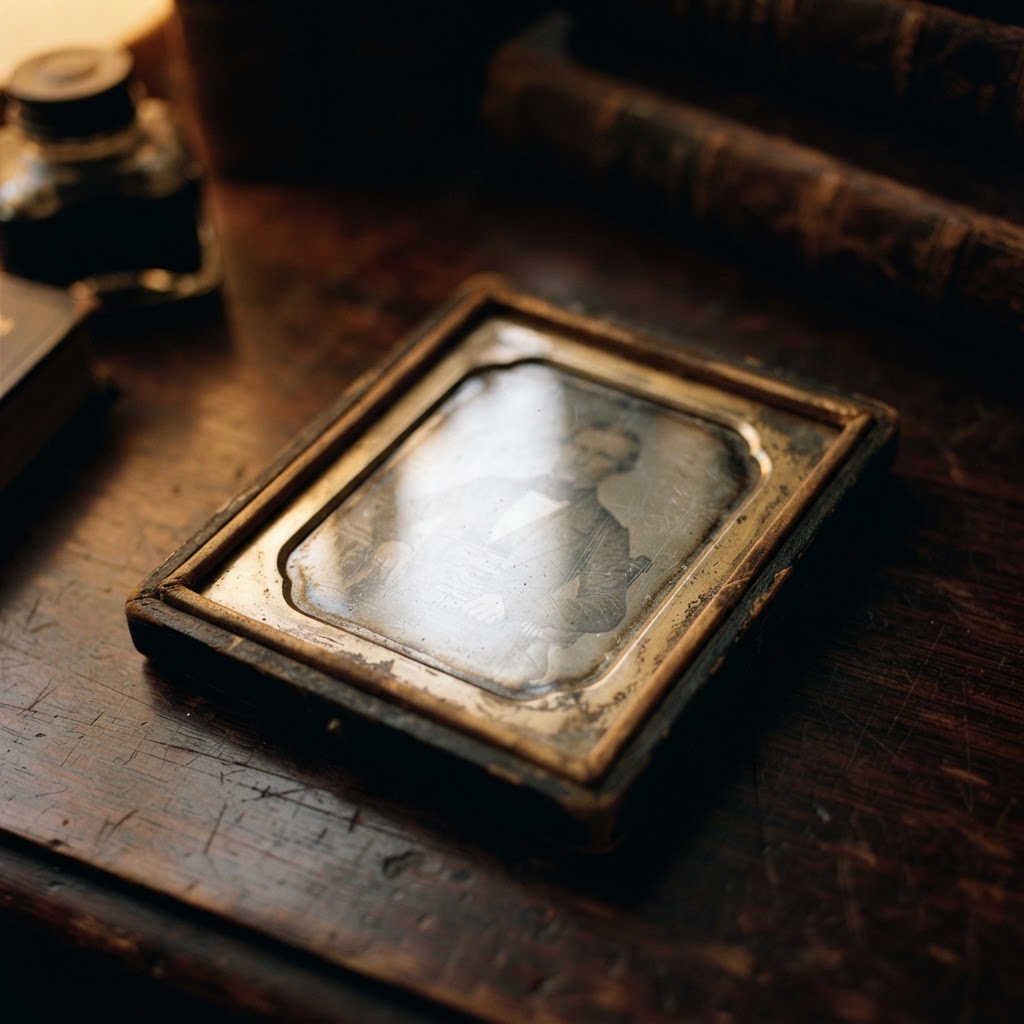
Because the Daguerreotype is a direct positive, each image is unique, existing as a singular artifact. This created a profound sense of intimacy and scarcity. Throughout its decade-long reign, the process evolved from requiring minutes of exposure—necessitating uncomfortable headrests for portrait sitters—to mere seconds, thanks to the introduction of bromine and chlorine accelerators. The final result is a breathtakingly sharp image, often encased in decorative leather or velvet frames to protect the delicate, fragile surface from oxidation.
- Sensitization: The volatile exposure to iodine fumes.
- Exposure: The precise calibration of light hitting the silver halide.
- Development: The dangerous, artistic use of heated mercury vapor.
- Fixing: The stabilization of the image using a sodium thiosulfate solution.
A Legacy of Clarity
As we navigate our digital era, the Daguerreotype reminds us that photography is an intersection of art and physics. It demanded patience, scientific rigor, and an unwavering respect for the chemistry of light. To hold a Daguerreotype is to stare into the eyes of a person from the 1840s and realize that while our tools have changed, the fundamental human desire to 'stop time' remains constant. It was the first true mechanical eye, and its legacy of precision remains the gold standard for our academy.