The Glass Paradox: Unveiling the Magic of the Petzval Portrait Lens
The Optical Revolution
In the earliest days of photography, portraiture was an exercise in extreme patience. The primitive lenses of the late 1830s, such as the Chevalier landscape lens, were agonizingly slow, requiring exposures that stretched from minutes to nearly an hour. For the subject, this meant holding a rigid, statue-like pose under the searing sun, often with the aid of metal headrests to prevent motion blur. The breakthrough came in 1840, when Joseph Petzval, a mathematician and physicist in Vienna, calculated the world’s first mathematically designed portrait lens. It was a revelation that would forever alter the aesthetic of the photographic portrait.
The Math Behind the Magic
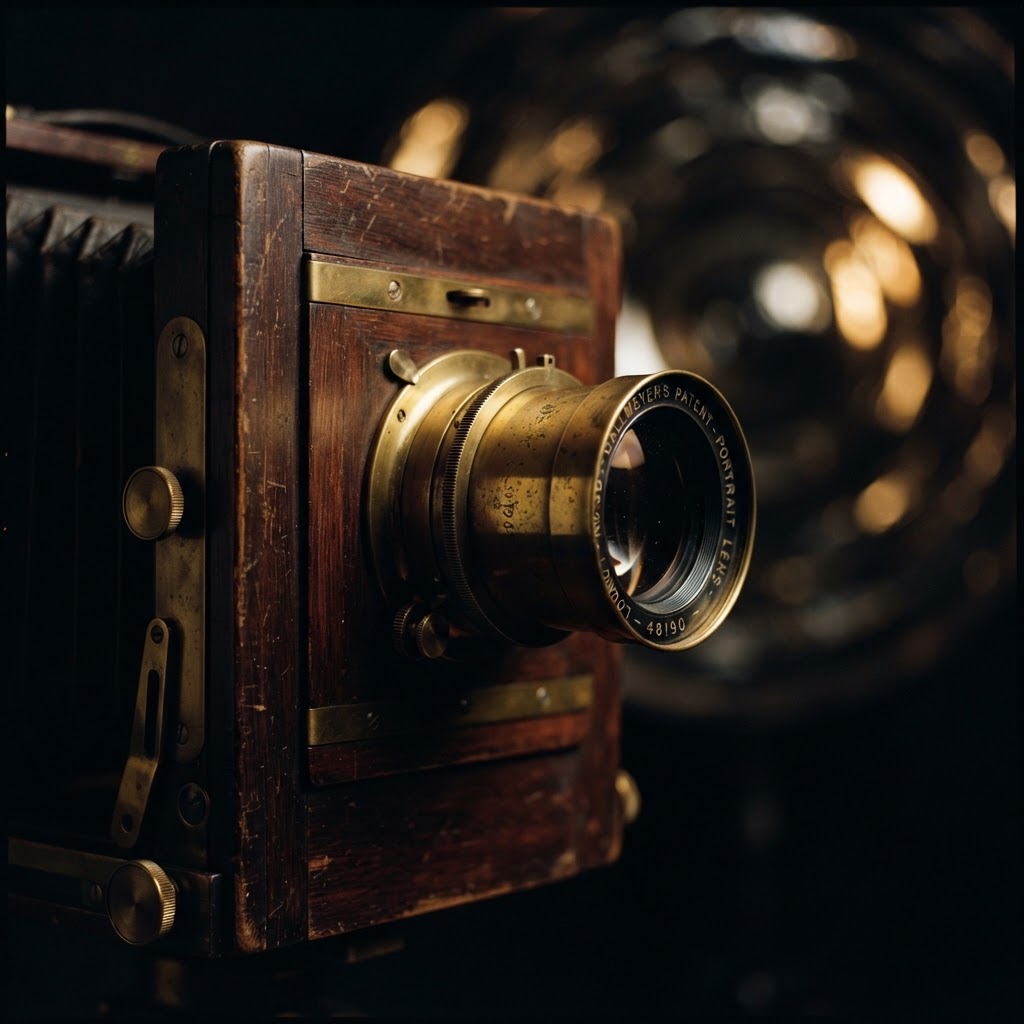
Petzval’s design was radical not just for its speed, but for its approach to physics. By utilizing a double-objective system, he achieved an aperture of approximately f/3.6—a massive jump in light-gathering capability compared to the f/15 lenses of the era. This allowed exposure times to drop to mere seconds. However, this speed came at a price: field curvature and a distinctive swirl in the bokeh. To the purists of the time, these were optical flaws. To the artists who followed, they became a unique, painterly signature that gave depth and focus to the human face while dissolving the background into a dreamlike vortex.
The Petzval Aesthetic
The characteristic 'swirly bokeh' of the Petzval lens is created by spherical aberration and field curvature. When wide open, the center of the frame remains tack-sharp, while the periphery stretches and spins. This creates an unintentional, yet beautiful, emphasis on the subject. It is as if the lens itself acts as a frame, isolating the human spirit within a swirling canvas of light and shadow. It is this specific quality that has led to a resurgence of the Petzval design in the digital age, as modern photographers seek the organic, imperfect texture that software filters fail to replicate.
A Legacy of Light
At Photography in the Raw, we often emphasize that gear is merely an extension of the photographer’s intent. The Petzval lens serves as the ultimate historical lesson in this philosophy. It teaches us that what we once perceived as a technical failure can, through the right perspective, become a hallmark of artistic intention. The lens did not just capture a person; it captured a mood, a surrounding atmosphere, and a sense of immediacy that had never been seen before. It turned the rigid, cold documentation of early photography into something soulful, intimate, and undeniably human.
The Petzval lens is proof that the most compelling images are often found in the margins of imperfection, where mathematical precision meets the chaotic beauty of light.
When you look at a wet-plate portrait shot with an original Petzval, you aren't just looking at an image of a Victorian subject. You are looking at a moment frozen by a unique piece of glass that manipulated reality to tell a more poetic story. Today, as we navigate high-resolution sensors and clinical sharpness, the Petzval lens remains a reminder that the goal of photography is not merely to capture what is in front of us, but to interpret it through a lens that values character above all else.