The Glass Eyes of the Deep: The Evolution of Underwater Photography
The Descent into the Blue
In the early days of photography, the challenge was capturing light on land. However, a restless breed of explorers turned their gaze toward the horizon, wondering what secrets lay hidden beneath the surface of the sea. Underwater photography did not begin as a quest for artistry, but as a struggle against the relentless physics of water, pressure, and refraction. It was a realm where the laws of optics seemed to conspire against the photographer, demanding courage, mechanical ingenuity, and an unwavering commitment to the craft.
The Pioneer’s Burden
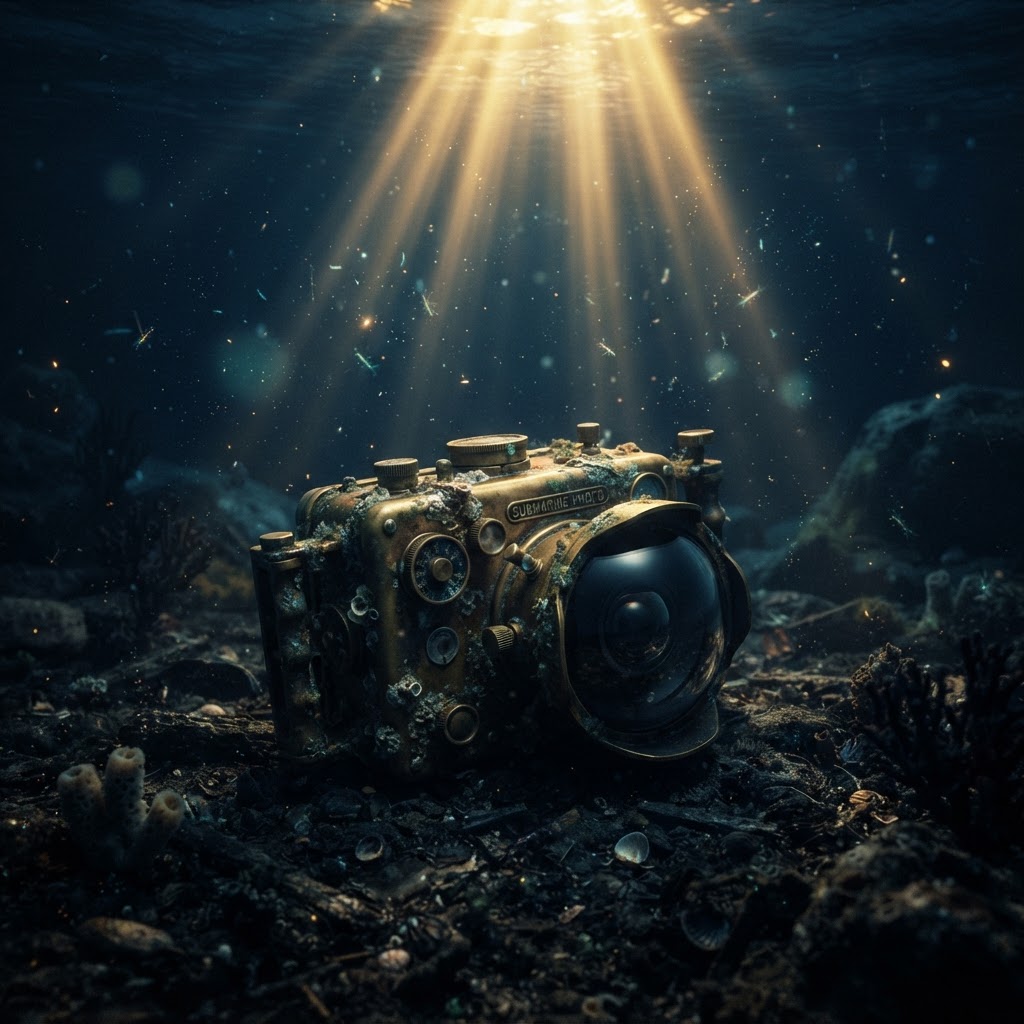
The first successful underwater photograph is credited to Louis Boutan, a French biologist who, in 1893, lowered his heavy camera into the Mediterranean. To achieve this, he utilized a copper-lined wooden box, relying on a system of rubber bulbs to manage air pressure. The resulting image was a grainy, ethereal silhouette, yet it was a revelation. It proved that the camera could penetrate the liquid veil. Boutan’s work laid the foundation for the specialized housing technology we see today, turning the camera into a submarine vessel.
The Physics of the Abyss
As we delve into the technical evolution of this field, we must acknowledge the primary antagonist: light. Water absorbs light differently than air, stripping away the red spectrum almost immediately, followed by orange and yellow. To shoot underwater is to shoot in a world of monochromatic blue. The mastery of this environment requires more than a steady hand; it necessitates a deep understanding of color temperature and the artificial injection of light. The development of waterproof strobes and, later, the invention of powerful LED arrays, allowed photographers to 'bring the sun' into the deep, restoring the vibrant spectrum of marine life.
The Revolution of the Housing
The mid-20th century saw a massive leap forward with the introduction of the Calypsophot, the world's first dedicated underwater 35mm camera, which would eventually evolve into the iconic Nikonos series. These cameras were not merely water-resistant; they were built to withstand the crushing weight of the ocean, designed with o-rings and precision gaskets that allowed photographers to move with the agility of the fish they were documenting. This democratization of underwater gear transitioned the discipline from the work of scientists to the canvas of artists.
The ocean is the final frontier of our planet, and the camera is the only tool that can translate its alien beauty for those who will never tread its depths.
The Digital Current
Today, the digital revolution has rendered the once-daunting constraints of the abyss more manageable. High ISO capabilities allow photographers to capture motion in low-light environments without losing the integrity of the image to noise. Moreover, the immediacy of the LCD screen allows for real-time adjustments in a medium where mistakes are costly and environmental conditions shift in a heartbeat. The underwater photographer of the modern era must be part-diver, part-engineer, and part-poet, waiting for the precise moment when the currents align and the light filters through the surface in a perfect, cathedral-like display.
A Legacy of Preservation
As we document the world beneath the waves, our role transcends mere documentation; we become the eyes of the public for a fragile ecosystem. The history of underwater photography is a testament to human curiosity. Every time we seal a camera into its housing, we are participating in a tradition that started with brass boxes and copper wires, carrying that legacy into the deepest trenches of our imagination. To photograph the ocean is to acknowledge our responsibility to protect it.