The Glass Eyes of Mars: The Viking Landers and Space Photography
The First Glimpse of Another World
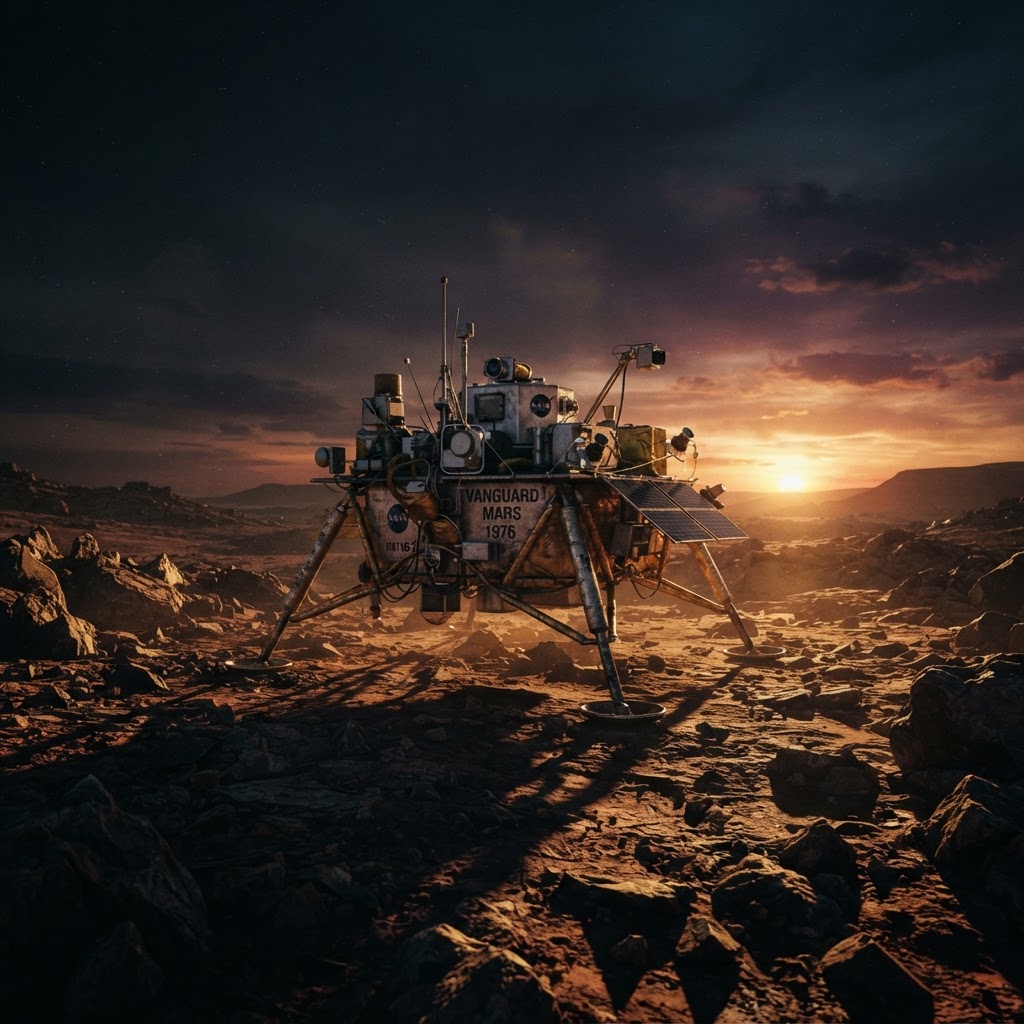
As photographers, we are often obsessed with the texture of the earth beneath our feet—the way light catches the grain of a leaf or the rugged silhouette of a mountain range. But there was a moment in 1976 when the collective gaze of humanity shifted upward, turning toward the rust-colored horizon of Mars. This was not the work of a handheld Leica or a medium-format masterpiece; it was the birth of true interplanetary photojournalism, realized through the pioneering efforts of the Viking 1 and 2 missions.
For those of us at Photography in the Raw, studying the history of photography often leads us to terrestrial masters. However, the true frontier of the medium has always been the marriage of optics and exploration. When the Viking landers touched down on the Chryse Planitia, they carried with them not traditional shutters, but high-resolution facsimile cameras. These were marvels of engineering, designed to bypass the limitations of film by digitizing light intensities directly through a vertical line scan.
The Technical Architecture of the Void
Unlike a standard camera that exposes an entire frame at once, the Viking landers utilized a scanning process. A tiny mirror would tilt and rotate, capturing a single vertical slice of the Martian surface, sending that data back to Earth as a radio signal. This was an arduous, painstakingly slow process. An entire panoramic image could take minutes—sometimes hours—to assemble. If a dust devil blew across the horizon during the scan, the resulting image would show a distorted, fragmented apparition, a glitch in the fabric of reality that inadvertently became the first abstract art of the red planet.
The landscape of Mars was not just a destination; it was a testament to the fact that photography is, at its core, the translation of light into human understanding.
The technical hurdles were immense. These cameras had to survive the intense thermal swings of space and the harsh, abrasive dust of an alien desert. To combat the lack of atmosphere and the potential for mechanical failure, the team at NASA employed:
- Line-Scan Technology: A revolutionary method for capturing high-fidelity images across immense distances.
- Spectral Calibration: Using reference targets to ensure that the colors of the Martian soil were rendered with scientific accuracy, rather than artistic interpretation.
- Bilinear Scanning: A sophisticated system allowing for focus adjustment at different distances, effectively creating depth of field in a vacuum.
The Aesthetics of the Alien Landscape
When the first images arrived, they were monochromatic, processed line by line in mission control. As the data was synthesized, the world watched in silence as the rocks of a distant world solidified on computer screens. It was a stark, lonely beauty. The lighting on Mars is unique—a soft, diffuse glow filtered through thin, dusty air that creates a distinct lack of deep shadows compared to a clear day on Earth. This forced the mission photographers to think in terms of tonal gradation rather than the high-contrast drama we often favor in the studio.
This era taught us that photography is an instrument of preservation. The images of Viking 1 were the first to provide a permanent record of a world that existed for billions of years without ever having been witnessed. They were the first "landscapes" in the truest sense of the word—a field of view that belonged to no nation, no artist, and no history but its own.
The Legacy of the Scanner
Today, as we look at the high-definition color streams from the Perseverance rover, we must remember the line-scanned pioneers. The Viking missions proved that our cameras are more than simple recording devices; they are extensions of our consciousness. Whether we are shooting in the streets of Frederick, Colorado, or pointing a lens at the cosmos, we are engaged in the same human pursuit: attempting to make sense of the light that surrounds us. The lens remains our most reliable companion in the search for truth, no matter how far that truth may be from home.