The Glass Specter: The Ghostly Art of Spirit Photography
The Convergence of Science and the Supernatural
In the mid-19th century, the public’s grasp of photographic chemistry was minimal at best. When the first spirit photograph was produced by William H. Mumler in the 1860s, it sent shockwaves through a society still reeling from the immense loss of the American Civil War. Photography, then a miraculous tool of documentation, was suddenly perceived as a portal to the afterlife.
The Birth of the Double Exposure
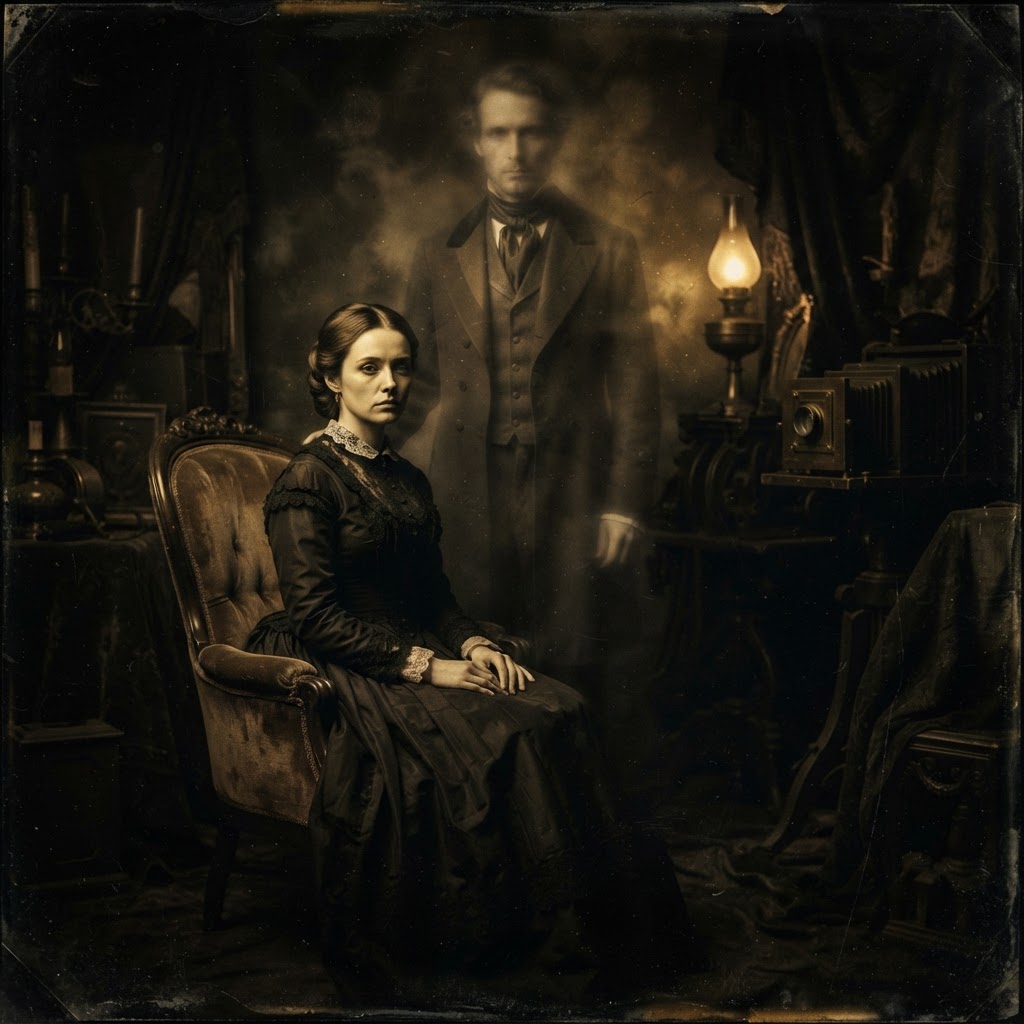
At the heart of the spirit photography phenomenon lay a simple, yet profoundly misused, technical secret: the double exposure. By partially exposing a photographic plate to an image of a deceased loved one—or a cloaked actor—before capturing the portrait of a living sitter, photographers like Mumler created an ethereal, translucent apparition. To the grieving mother or the mourning husband, the result was not a chemical artifact; it was undeniable proof of the soul’s persistence.
The Master of Manipulation
William H. Mumler, a Boston jewelry engraver turned photographer, became the movement’s most famous practitioner. His studio was a pilgrimage site for the bereaved, including Mary Todd Lincoln, who allegedly sat for a portrait only to find the phantom of her late husband standing behind her. Despite legal challenges and accusations of fraud, the allure of the spirit photograph was too strong to be extinguished by mere logic.
The lens does not lie, but it can be taught to dream. Spirit photography was a testament to the human need for closure in the face of absolute loss.
The Mechanics of Deception
To understand the era, one must understand the limitations of the wet-plate collodion process. Practitioners employed several techniques to craft their ghosts:
- Double Exposure: Superimposing latent images onto a plate.
- Masking: Using physical screens to block parts of the frame during secondary exposures.
- Positive Transparencies: Placing cut-out photographs of individuals onto a glass plate to print them alongside the subject.
By the time investigators like P.T. Barnum and the legendary Harry Houdini began to debunk these claims, the genre had already firmly rooted itself in the cultural zeitgeist, forever blurring the line between empirical evidence and the longing of the human heart.
Legacy of the Invisible
While we look back at spirit photography today as a collection of clever optical illusions, we must recognize its importance as a precursor to modern visual manipulation. It was the first time in history that the camera was used not to record reality, but to construct a narrative—to provide comfort where science could offer none. As photographers in the digital age, we possess tools far more sophisticated than a simple double exposure, yet the ghost in the machine remains an enduring motif. We are still, in many ways, chasing the light that hides in the shadows of our frames.