The Brownie Revolution: How Kodak Democratized the Captured Moment
The Simple Box That Changed Everything
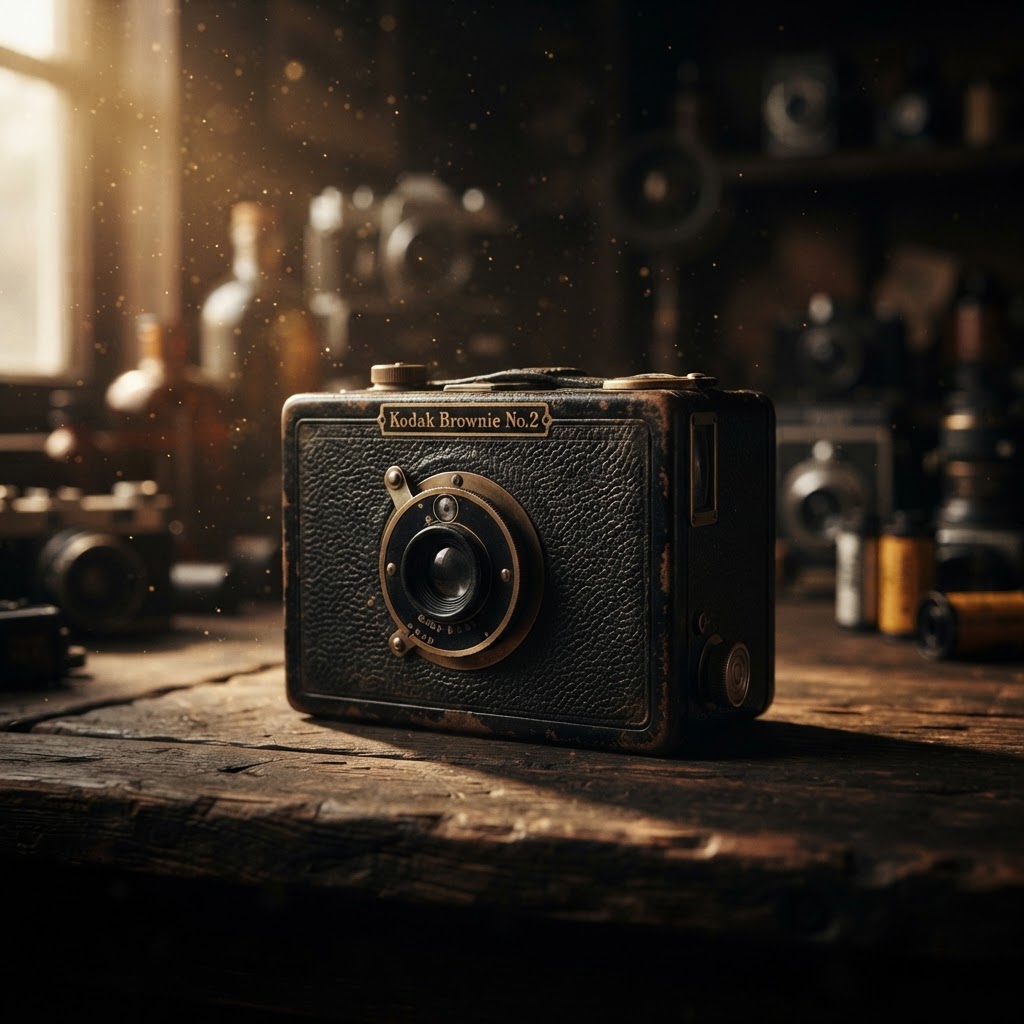
In the late 19th century, photography was a somber, technical, and expensive affair. It belonged to the chemist, the alchemist, and the wealthy traveler who could afford the weight of a tripod and a mobile darkroom. That changed in February 1900 with the release of the Kodak Brownie. It was not merely a camera; it was a societal earthquake disguised as a cardboard box. As we study the evolution of our craft at Photography in the Raw, we often look toward the complex optics of today, but we owe our current accessibility to the humble engineering of George Eastman's most brilliant invention.
The Anatomy of Accessibility
The original Brownie cost one dollar—a price point so revolutionary that it was immediately accessible to the working class. It was manufactured from heavy cardboard, covered in imitation leather, and featured a simple meniscus lens. It didn't have a sophisticated shutter or a complex rangefinder. It operated on a single, fixed aperture and a single shutter speed. Yet, this inherent limitation was its greatest strength.
The genius of the Brownie was not in what it could do, but in what it allowed others to do: capture the unscripted truth of everyday life.
By removing the barriers of technical mastery, Kodak invited the masses to participate in the act of witnessing. Photography shifted from a formal portraiture ritual to a spontaneous documentation of family picnics, children playing in the yard, and the quiet rhythms of domestic existence.
The Workflow of the Masses
Kodak understood that the camera was only half the battle. They introduced the 'Kodak Girl' and the mantra, You press the button, we do the rest. This was the world's first true outsourcing of the darkroom. The user would expose the film, mail the camera—or later, the film cartridge—back to the factory, and receive back a set of processed negatives and prints. This cycle established the foundational workflow of modern photography: capture, process, and output.
- Simplicity: The fixed-focus lens ensured that nearly everything from five feet to infinity was acceptably sharp.
- Durability: Despite its cardboard construction, the Brownie was rugged enough to be taken on trips across the globe.
- Democratization: By targeting children through a branding campaign featuring the 'Brownie' characters, Kodak captured an entire generation of future photographers.
A Legacy of Unfiltered Truth
When we look at the archives of the early 20th century, we see the impact of the Brownie in the candid nature of the images. People were no longer freezing for thirty seconds in a studio; they were laughing, moving, and existing in their natural environment. The Brownie taught the world to see the value in the 'snapshot.' This was the birth of the personal narrative—the idea that our mundane lives were worth preserving for posterity.
As contemporary photographers, it is easy to get caught up in the race for the latest high-resolution sensor or the sharpest prime lens. However, the Brownie serves as a humbling reminder that the soul of photography does not reside in the hardware. It resides in the intent. It resides in the act of choosing what moment is worth holding onto, even when the tools are nothing more than a box and a bit of silver halide.
Today, as we navigate the digital age, the Brownie stands as the ancestor of every smartphone and every mirrorless camera we use at Salt Media Studios. It reminds us that at its core, photography is a shared language. It is the bridge between the transient moment and the permanent memory. Whenever you find yourself overcomplicating your craft, look back to the Brownie. Strip away the extra glass, the complex menus, and the obsession with sharpness, and ask yourself: what is the story I am trying to tell?