The Decisive Geometer: Henri Cartier-Bresson and the Art of Time
The Architect of the Instant
To speak of Henri Cartier-Bresson is to speak of the very pulse of photography. Before he was a master of the lens, he was a student of painting, an enthusiast of Surrealism, and a restless traveler. Born in 1908 in France, Cartier-Bresson brought an artist’s eye for composition to the volatile world of 35mm reportage. He did not simply record scenes; he organized chaos into a singular, balanced composition where every element found its inevitable place.
The Geometry of Reality
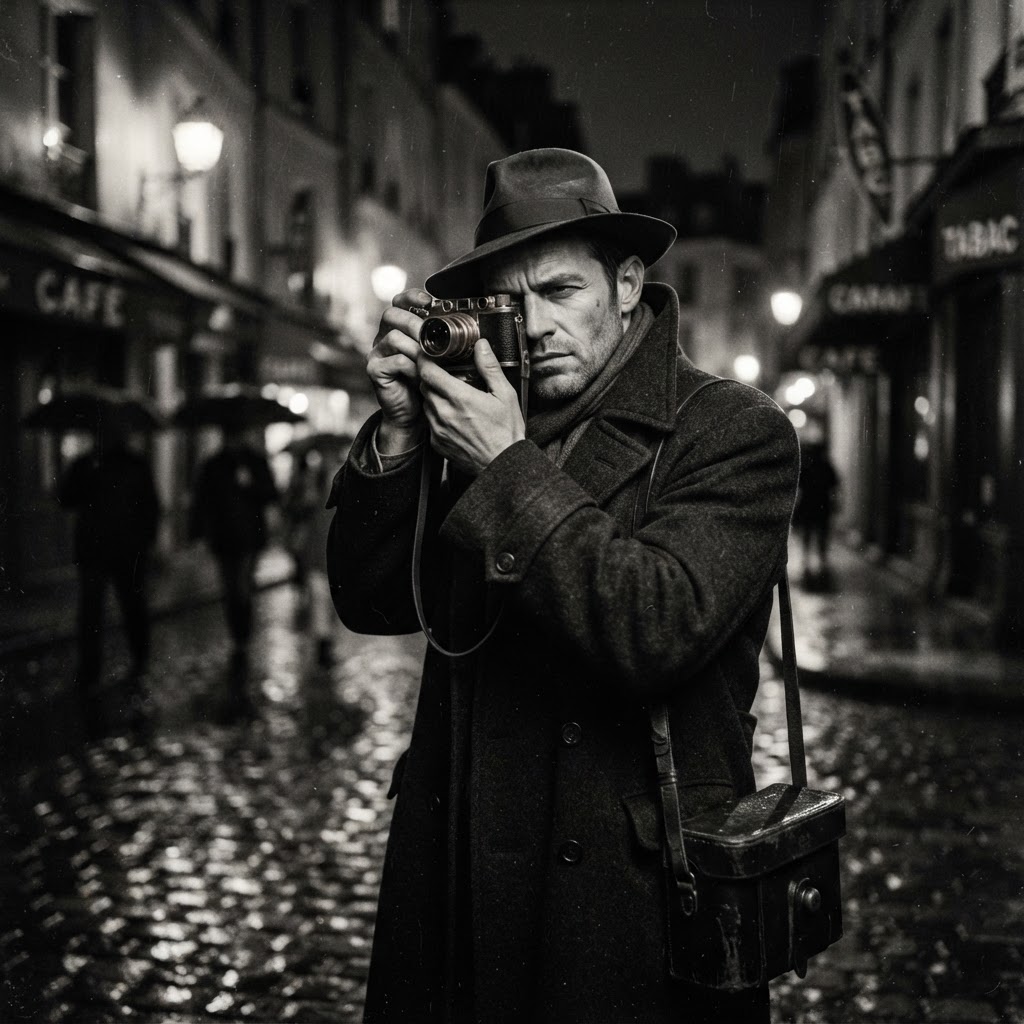
Cartier-Bresson famously pioneered the concept of the Decisive Moment—the split second when the formal elements of a photograph align perfectly with the psychological truth of the subject. For him, the camera was an extension of his own nervous system. He famously avoided the flash, preferring the natural, subtle light of the streets, and he kept his Leica almost hidden, allowing him to operate with the invisibility of a phantom. His technique was simple: total immersion, minimal gear, and a relentless pursuit of geometric harmony.
The camera is for me a sketchbook, an instrument of intuition and spontaneity, the master of the instant which, in visual terms, questions and decides simultaneously.
Iconic Works and Humanism
Perhaps his most enduring work, Behind the Gare Saint-Lazare (1932), epitomizes his genius. A man leaps over a puddle, his reflection captured in the water, mimicking the posture of the dancer on the advertisement plastered on the wall behind him. It is a visual rhyme, a collision of architecture and movement that defies the accidental nature of the medium. His work during his travels across China, India, and the Soviet Union further solidified his role as a humanist chronicler, finding profound dignity in the everyday lives of the marginalized and the powerful alike.
The Legacy of the Leica
Cartier-Bresson’s impact on photography is immeasurable. He stripped away the artifice that often plagued early 20th-century photography, advocating for an uncropped, full-frame aesthetic that respected the integrity of the original capture. His work reminds us that:
- Composition is an intuitive act, not a rigid checklist of rules.
- Patience is a technical skill, as vital as shutter speed or aperture.
- Empathy is the primary lens through which a photographer should view the world.
As we navigate an era defined by endless digital manipulation and rapid-fire production, Cartier-Bresson’s insistence on the "decisive" nature of a single, unadulterated frame remains a masterclass for us all. He showed us that the world is a stage, and with the right amount of patience and perception, the photographer is not merely a witness, but a conductor of light and shadow.