Edward Weston: The Alchemist of Form and the Precision of Light
The Architect of the Absolute
In the pantheon of photographic history, few figures loom as large or as quiet as Edward Weston. While his contemporaries often sought to emulate the soft, painterly qualities of the pictorialists, Weston embarked on a different path—one of stark, uncompromising clarity. He viewed the camera not as a tool for interpretation, but as a mechanism for revelation. To look at a Weston photograph is to see the physical world stripped of its casual distractions, revealing a skeletal, crystalline beauty that resides beneath the surface of reality.
A Life Committed to Seeing
Born in 1886 in Highland Park, Illinois, Weston began his career with a Kodak Bulls-Eye camera, quickly finding his footing in the late pictorialist era. However, his journey was defined by a profound evolution. By the 1920s, while living in Mexico, his aesthetic underwent a radical transformation. Influenced by the vibrant culture and the sharp, high-contrast sunlight of the region, he abandoned the soft-focus lenses and manipulative printing techniques of his youth. He turned toward 'straight photography,' a movement he would eventually help formalize alongside Ansel Adams and Imogen Cunningham through the formation of Group f/64.
For Weston, the camera was an extension of the eye, a device capable of capturing the 'quintessence' of an object. He famously declared, 'The camera should be used for a recording of life, for rendering the very substance and quintessence of the thing itself.' This was not merely an aesthetic choice; it was a philosophical stance. He demanded that the photographer possess a 'pre-visualization' of the image—a mental clarity that precedes the shutter click.
Signature Techniques: The Geometry of the Ordinary
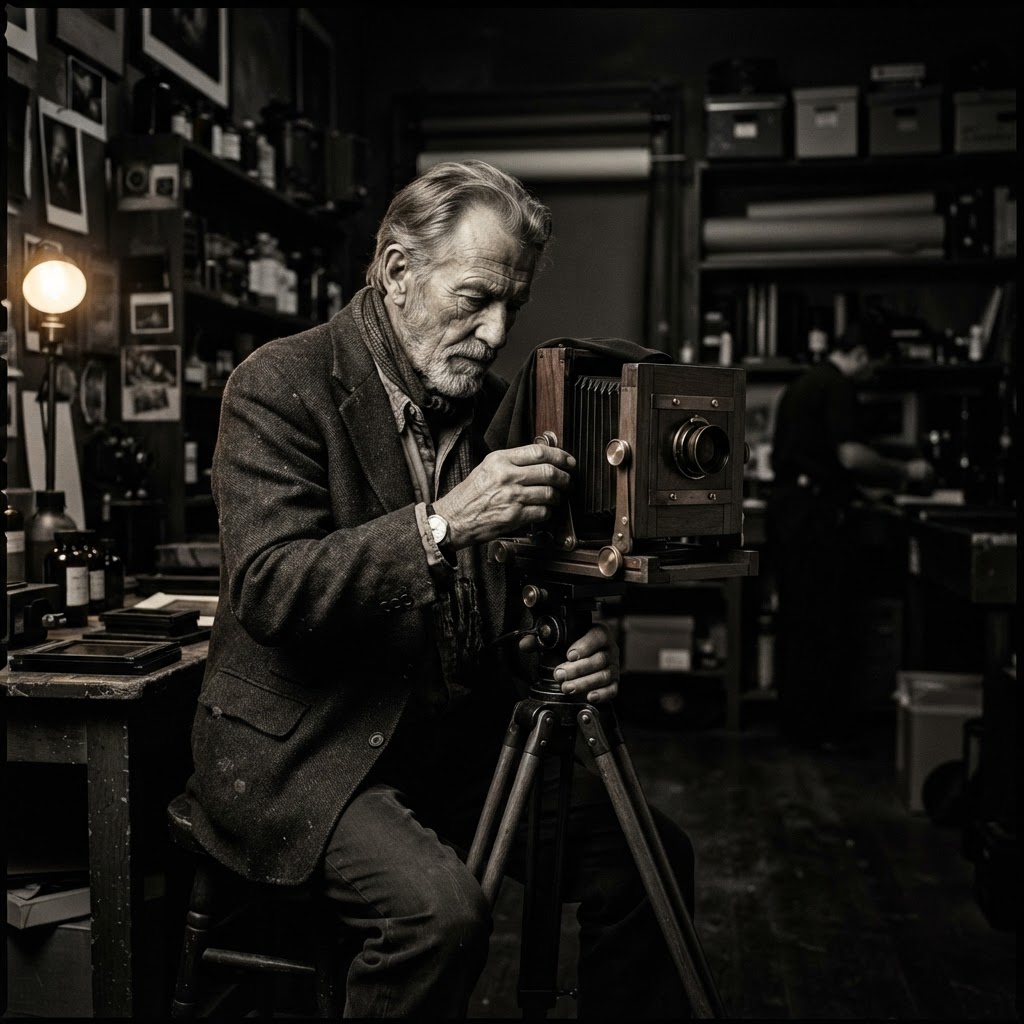
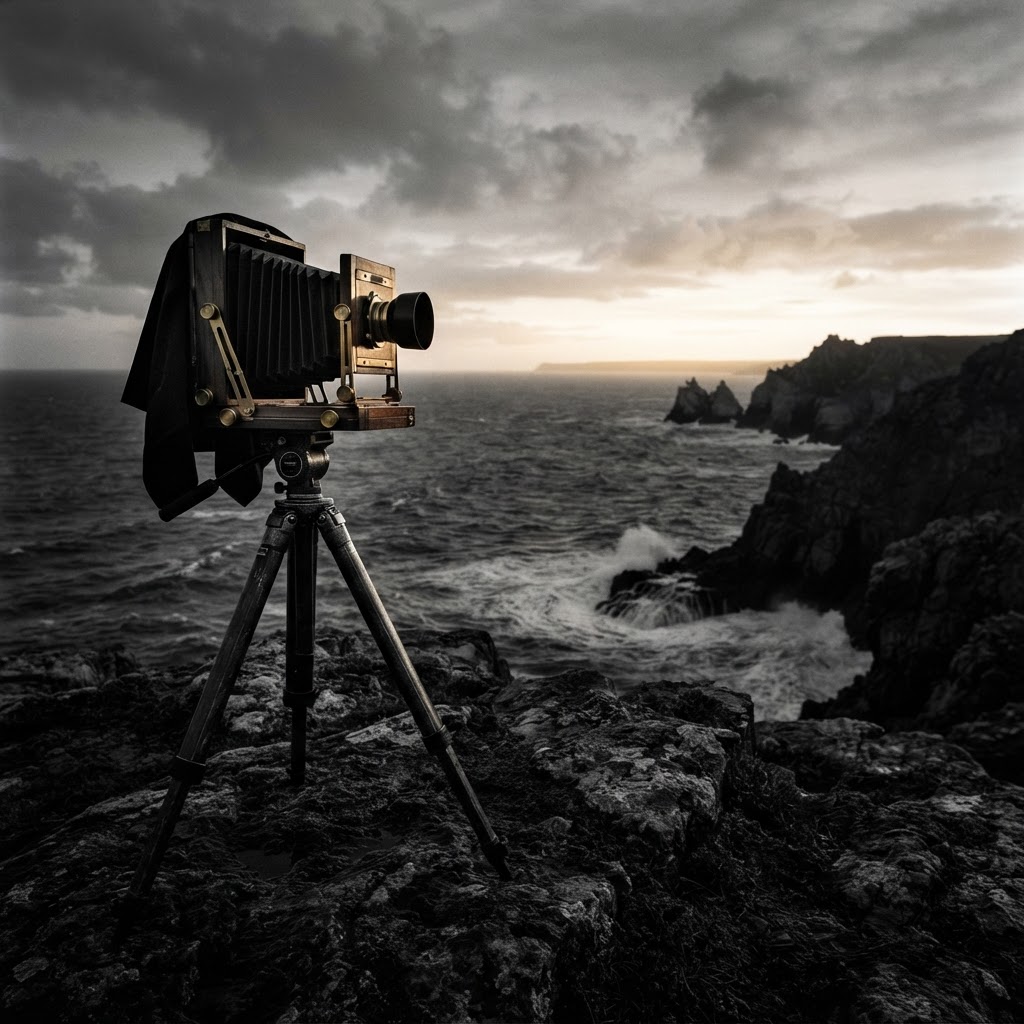
Weston’s technique was rooted in the technical discipline of the view camera. He worked almost exclusively with an 8x10 inch large-format camera, a behemoth that required patience, a heavy tripod, and a deep understanding of light. Because he shot on large-format film, he was able to achieve a degree of detail that felt superhuman, turning common objects—a bell pepper, a nautilus shell, the trunk of a cypress tree—into complex, sculptural studies of form and texture.
The camera, if properly used, will produce a print that is a direct, honest, and profound record of a moment in time, stripped of the artifice that obscures truth.
His mastery of the contact print is legendary. By printing directly from the negative without enlargement, Weston ensured that every microscopic detail captured by the lens remained intact. His prints, characterized by a deep, velvety scale of grays, were not just photographs; they were physical objects of extreme precision. He mastered the play of light against texture, utilizing the side-lighting that emphasized the volumetric quality of his subjects, turning a simple organic form into a landscape of shadows and highlights.
Iconic Works and the Power of Stillness
Perhaps his most famous work, 'Pepper No. 30' (1930), serves as the definitive example of his genius. By isolating a common bell pepper against a dark, featureless background, he transformed a household item into something evocative of the human form, fluid, tense, and monumental. It is an image that challenges the viewer to see beyond the object’s name and into its physical presence.
Weston’s landscapes, particularly those captured at Point Lobos, California, offer a similar intensity. He didn't just photograph rocks and trees; he mapped the history of time written in stone. These images remain vital today because they remind us that the world is inherently abstract if we are willing to look closely enough. He taught us that photography is the art of subtraction—removing the chaos of the world until only the essential structure remains.
The Lasting Legacy
Edward Weston struggled for much of his life with the financial instability that often plagues the dedicated artist. Yet, his commitment to his vision never wavered. He suffered from the debilitating effects of Parkinson's disease in his later years, which eventually forced him to lay down his camera. He spent his final days overseeing the printing of his 'Project Prints' by his sons, ensuring his legacy was preserved in the highest quality possible.
Why does Weston still matter in the age of digital saturation? Because in an era where we can manipulate every pixel into hyper-reality, Weston’s work stands as a testament to the power of the authentic gaze. He invites us to slow down, to engage with the physical world, and to find the divine in the mundane. His work is a reminder that the photographer's greatest asset is not the gear in their bag, but the capacity for sustained, focused attention.