Man Ray: The Surreal Alchemist of the Modern Lens
The Rebel of the Surrealist Vanguard
To speak of Man Ray is to speak of the man who refused to allow the camera to be a mere recorder of reality. Born Emmanuel Radnitzky in 1890, this Philadelphia-born artist found his true voice amidst the burgeoning chaos of the European avant-garde. Moving to Paris in 1921, he fell into the orbit of the Dadaists and later became a foundational pillar of Surrealism. For Man Ray, the camera was not a documentarian's notebook; it was a brush, a chisel, and a portal into the dreamscape.
The Alchemy of the Darkroom
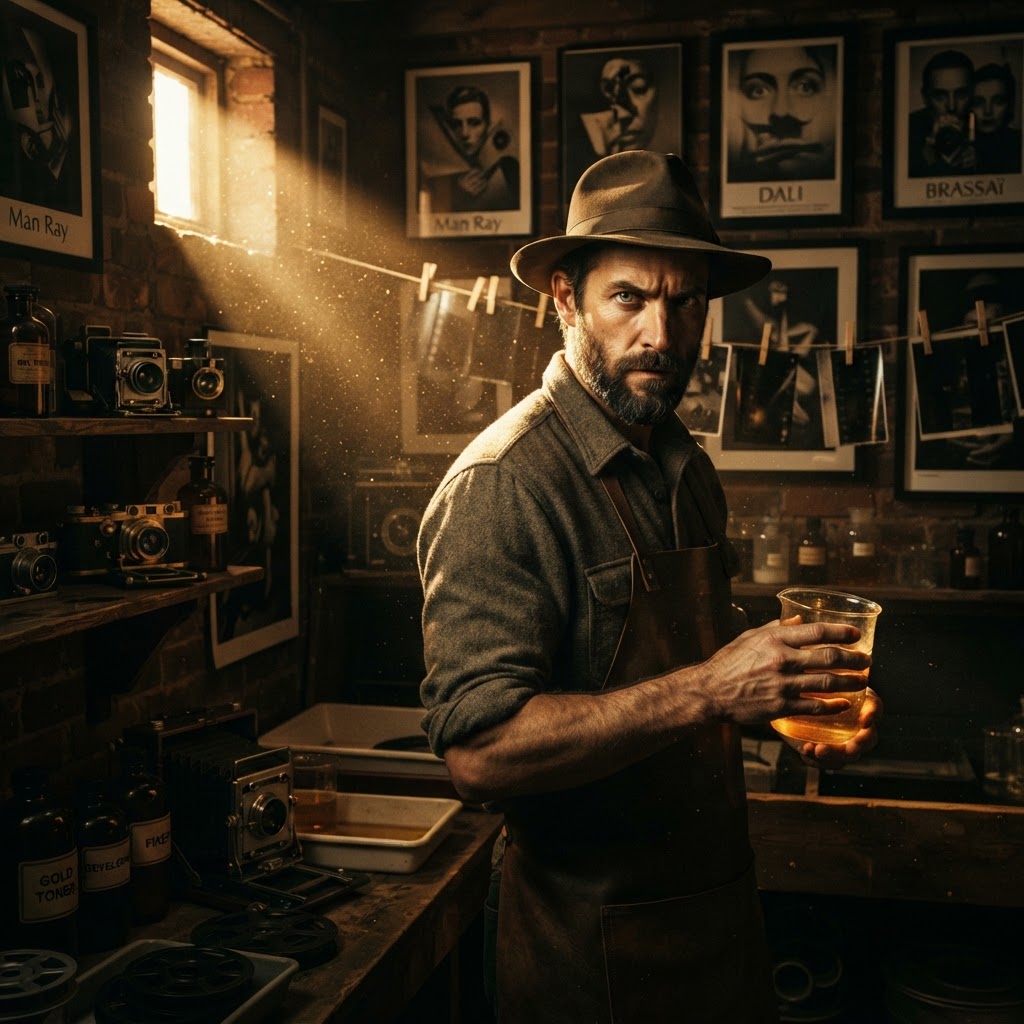
Man Ray’s genius lay in his willingness to break the machine. He treated his darkroom like an alchemist’s laboratory, famously 'rediscovering' the solarization process—a technique where partial exposure of a negative or print during development causes a reversal of tones. This gave his portraits an eerie, sculptural quality, stripping his subjects of their mundane reality and replacing it with a metallic, ethereal glow.
His signature techniques challenged the very definition of the medium:
- Rayographs: By placing objects directly onto photographic paper and exposing them to light without a camera, he bypassed the lens entirely, creating ghostly, abstract silhouettes that felt like artifacts from another dimension.
- Solarization: Using light leaks to create sharp, luminous halos around his subjects, he transformed flesh into liquid silver.
- The Assemblage Eye: He viewed photography through the lens of sculpture, often manipulating subjects with props, masks, or rhythmic, repetitive patterns that distorted space and time.
Iconic Visions of the Subconscious
Perhaps no image defines his career as starkly as Le Violon d'Ingres. By painting f-holes onto the back of his muse and lover, Kiki de Montparnasse, he turned the human form into a musical instrument. It is a playful, provocative, and deeply symbolic work that highlights his obsession with the intersection of art history and personal fetish. Similarly, Noire et Blanche showcases his mastery of contrast and form, juxtaposing the smooth, carved features of an African tribal mask with the pale, dormant face of a woman—a silent dialogue between the primitive and the modern.
The Legacy of a Defiant Spirit
Man Ray was more than a photographer; he was an interdisciplinary pioneer who worked in painting, sculpture, film, and ready-mades. He viewed his photography as a means of 'liberating' the artist from the tedious necessity of representation. By focusing on the texture of light and the ambiguity of the shadow, he forced his audience to look not at the world, but at the emotions the world triggers.
The camera is just a tool, like the pencil or the brush. It is the eye behind the lens—and the mind behind the eye—that dictates whether the final result is a record of fact or a fragment of a dream.
In an era obsessed with sharpness and clinical precision, Man Ray reminds us that the greatest power of photography lies in its capacity for distortion. He taught us that a photograph could lie, that it could mourn, and that it could suggest the impossible. His influence echoes through the works of fashion photographers, abstract artists, and cinematic visionaries who continue to use the darkroom and the digital sensor to explore the uncanny.
Today, as we navigate a world saturated with hyper-realistic imagery, Man Ray’s work serves as a necessary provocation. He invites us to step away from the literal and embrace the interpretive. He was, and remains, the architect of the invisible, proving that when the photographer stops trying to capture the world, they finally begin to capture the soul.