The Velocity of Light: Eadweard Muybridge and the Birth of Motion
The Anatomy of a Gallop
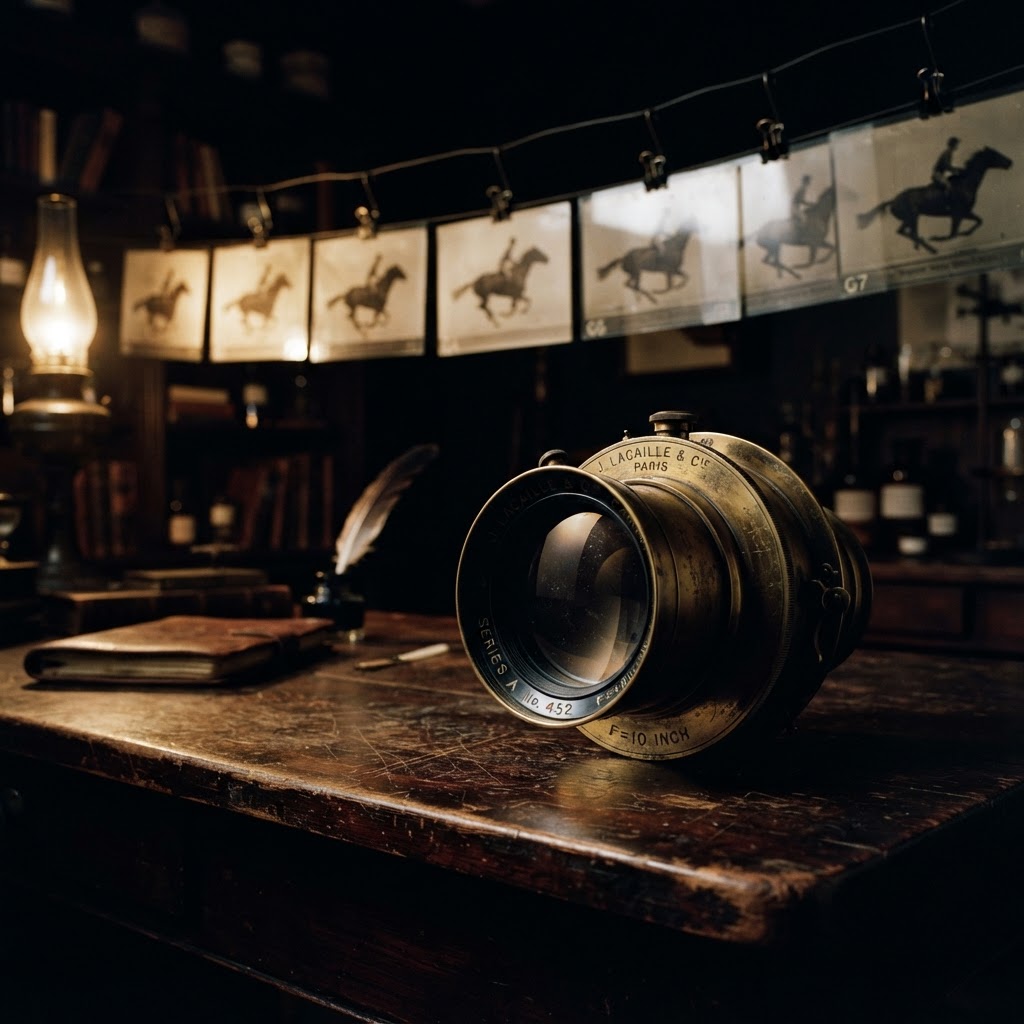
For centuries, artists and scientists alike were shackled by the limitations of human perception. When a horse galloped, the human eye saw a blur, a frantic impression of movement that rendered the true biomechanics of the animal impossible to document. That changed in 1878, when Eadweard Muybridge, a photographer of restless ambition, set a row of cameras along a California racetrack to settle a wager regarding whether a horse ever truly leaves the ground during a full gallop. The result was not merely a proof of physics, but the birth of a new visual language: the chronological decomposition of motion.
The Technological Crucible
Muybridge’s feat was far more than a simple shutter release. It required the invention of a bespoke electrical shutter system triggered by tripwires laid across the track. As the horse broke the wires, a sequence of images was captured, each in a fraction of a second. This was the precursor to cinema—the realization that time could be segmented, analyzed, and reconstructed. His work with 'The Horse in Motion' dismantled the romanticized, artistic depictions of galloping horses that had dominated painting for decades, replacing them with the cold, hard, and undeniably graceful truth of anatomy.
The eye is a deceptive witness; it captures only the impression of a moment, not the reality of the mechanism. Muybridge taught us that the camera is the only honest observer of the physical world.
The Zoopraxiscope and the Illusion of Life
Following his success on the track, Muybridge did not simply rest on his laurels; he sought to restore that motion to the viewer. He developed the Zoopraxiscope, a device that projected his sequence of images in rapid succession, creating an optical illusion of continuous movement. This was the foundational alchemy that would eventually lead to the invention of the motion picture camera. His studies expanded into the human form, cataloging the nuances of walking, jumping, and lifting, which remain essential references for animators, biologists, and artists to this day.
- Precision Engineering: The synchronization of twelve, then twenty-four individual cameras.
- Analytical Rigor: The move from subjective portraiture to objective scientific documentation.
- The Foundation of Motion: How these glass-plate sequences laid the groundwork for modern frame-rate cinematography.
The Legacy of the Frozen Moment
At Salt Media Studios, we often discuss the importance of capturing a 'decisive moment,' but Muybridge reminds us that every moment is a composite of micro-actions. His work stripped away the facade of static existence, revealing the frantic, beautiful, and precise dance of muscle and bone. By freezing time, he unlocked the ability to see what was previously invisible, transforming photography from a medium of stillness into a medium of time. As contemporary photographers, we owe our ability to analyze light and movement to those initial, gritty experiments on a sunny track in Palo Alto. His legacy is a testament to the idea that when we control the shutter, we do not just capture an image; we capture a truth that exists only in the spaces between our heartbeats.