The Measured Gaze: A History and Evolution of the Light Meter
The Anatomy of Certainty
In the quiet, deliberate spaces of Salt Media Studios, I often watch students struggle with the ephemeral nature of light. We are taught to 'see' light, yet the camera remains a cold, calculating machine that requires a mathematical translation of that vision. Enter the light meter: the bridge between the artist’s subjective perception and the objective reality of the sensor or film plane. To understand photography, one must understand the tool that turned exposure from a hopeful guess into a repeatable science.
Etymology and the Genesis of Quantification
The term 'light meter' is a straightforward compound of the Old English leoht and the Greek metron, meaning measure. While the nomenclature seems modern, the impulse to quantify light dates back to the early 19th century. Early photographers, working with plates that had the sensitivity of a stone, relied on intuition and exposure tables. The 'light' was not something to be measured so much as something to be endured.
As photographic chemistry advanced—moving from the unpredictable Daguerreotype to the more consistent dry plates—the need for a mechanical arbiter became clear. The history of the light meter is, in many ways, the history of the struggle to harmonize the erratic nature of the sun with the rigid chemistry of silver halides.
From Actinometer to Selenium
Before the electronic age, we had actinometers. These devices operated on a simple, albeit slow, principle: exposing a piece of light-sensitive paper until it matched a control tint. It was a crude, time-consuming affair, but it forced the photographer to observe the intensity of the light hitting the subject directly. It was not a tool for the 'decisive moment,' but for the methodical, pre-visualized capture.
The revolution arrived with the advent of the photoelectric cell. In the 1930s, the development of the selenium cell allowed for the first 'instant' readings. Suddenly, the photographer did not need to wait for paper to darken. A needle danced across a dial, translating photons into foot-candles. This transition shifted photography from a craft of long-form estimation to one of rapid, technical calculation.
Reflective vs. Incident: The Philosophical Divide
In the academy, I frequently emphasize the distinction between reflective and incident metering. This is more than a technical preference; it is a philosophical stance.
- Reflective Metering: This measures the light bouncing off your subject. It is what the camera in your hand does by default. It is intuitive but flawed, as it assumes the world is a neutral 18% gray. It sees a white wall and tries to darken it, or a black coat and tries to lighten it.
- Incident Metering: This measures the light falling onto the subject. By placing the meter at the subject's position, we remove the variables of tone and texture. It is the most honest reading of the light itself.
To meter incident is to trust the light as it is, rather than how the camera perceives the subject. It is the hallmark of the master who prioritizes the quality of illumination over the mere capture of reflected data.
The Digital Transformation
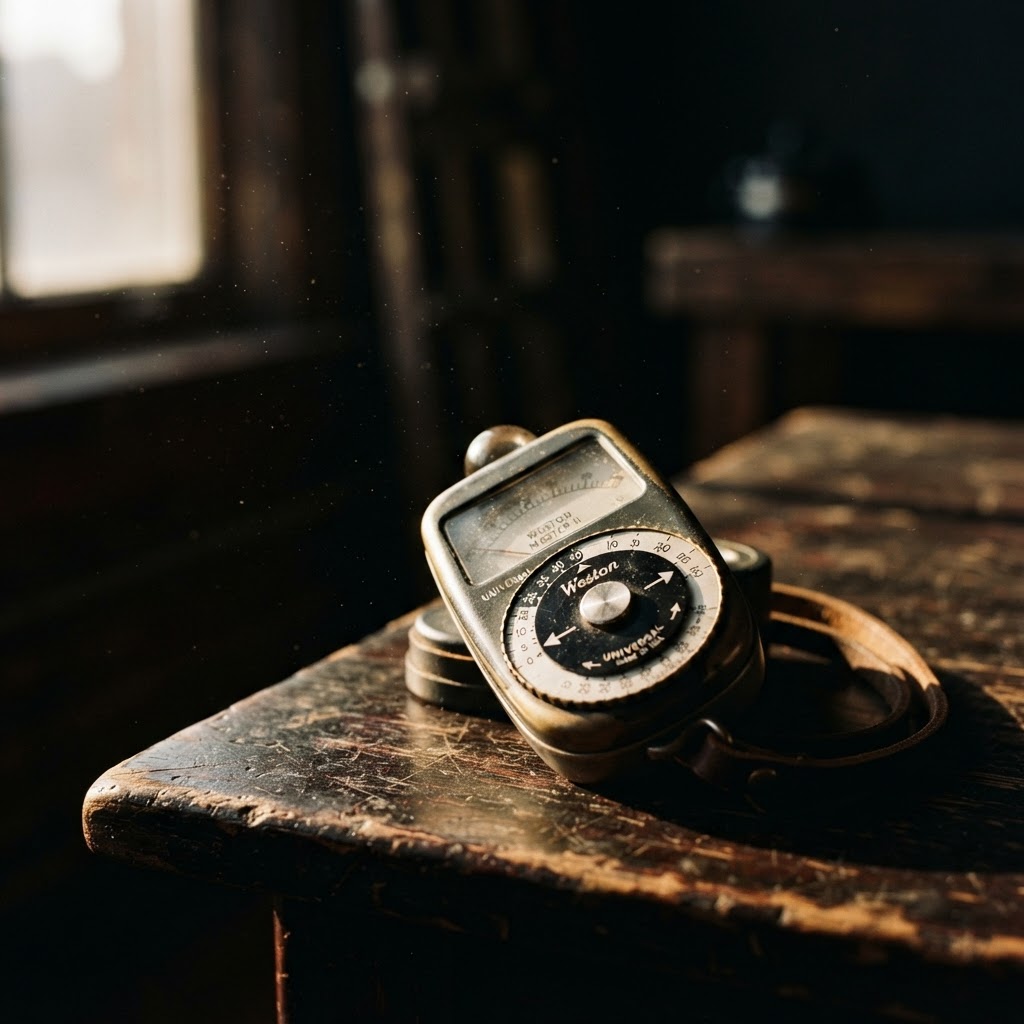
Today, internal light meters are so sophisticated they include facial recognition and evaluative algorithms that process thousands of data points. Yet, there remains a persistent romance and utility in the handheld meter. When I step out with a large-format camera or a vintage rangefinder, the act of pulling a Sekonic from my bag is a grounding ritual. It forces me to pause. It demands that I move toward my subject, stand in their light, and acknowledge the physical space we occupy together.
Conclusion
The light meter is perhaps the most misunderstood instrument in the photographer’s arsenal. It is not merely a tool for technical accuracy; it is an instrument of engagement. By learning to measure light, we learn to respect its intensity, its direction, and its transient nature. As you continue your journey at Photography in the Raw, remember that the numbers on your display are not just data—they are the language of your vision translated into light.