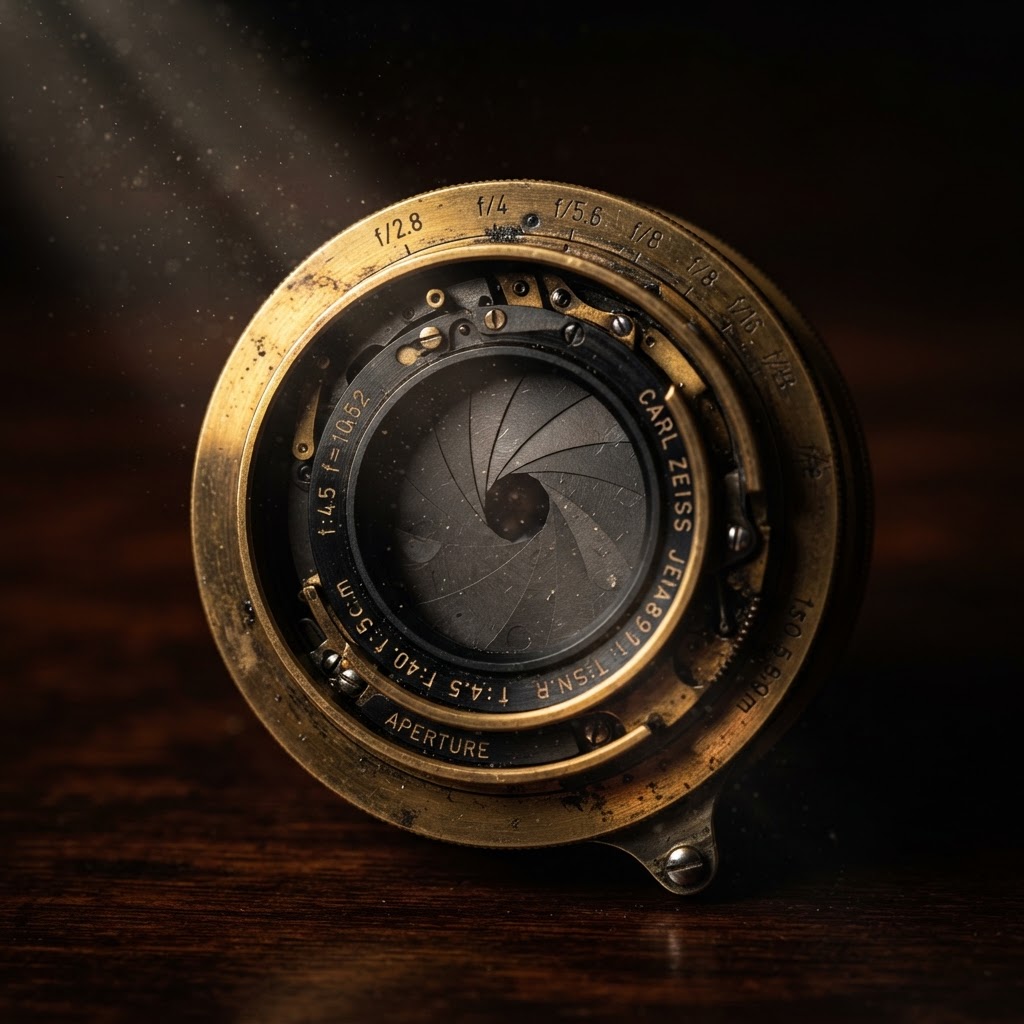
The F-Stop Defined: A History of Aperture and Optical Precision
The Anatomy of an Aperture
As we navigate the intersection of science and artistry at Salt Media Studios, we often return to the building blocks of our craft. While many photographers treat the f-stop as a mere habit—a click of the dial to adjust exposure—its true nature is grounded in the rigorous mathematics of 19th-century optics. To understand the f-stop is to understand the language of light itself.
Etymology and the Genesis of the 'F'
The term 'f-stop' carries a deceptively simple nomenclature. The 'f' stands for focal length, and the stop represents a physical limit placed upon that length. In the late 19th century, as lens designers like Ernst Abbe and Carl Zeiss began to move photography from an alchemical experiment to a disciplined science, they required a standardized system to express the 'speed' of a lens. Before this standardization, photographers were plagued by varying systems of numbering aperture sizes, often unique to each individual lens manufacturer.
The mathematical breakthrough was the recognition that the light-gathering power of an aperture depends on the ratio of the lens's focal length to the diameter of the entrance pupil. Thus, the formula was born: f = F/D, where f is the f-number, F is the focal length, and D is the diameter of the aperture. By defining it as a ratio rather than a raw measurement, scientists created a universal language. Whether you are shooting with a 35mm prime or a 400mm telephoto, an f/8 setting indicates the same relative light-gathering capability and depth of field potential.
The Evolution of a Standard
The system we recognize today—f/1.4, f/2, f/2.8, f/4, f/5.6, f/8, f/11, f/16, and f/22—was not plucked from the ether. It is built on the square root of two, approximately 1.41. Each 'full stop' represents a doubling or halving of the light hitting the sensor or film. Because the area of a circle is proportional to the square of its radius, the numbers follow a sequence that ensures that every full stop increment perfectly halves or doubles the amount of light.
The f-stop is the pulse of the photograph; it determines the intimacy of the focus and the weight of the shadow. - Robert Morrissey
Technical Precision in the Field
Beyond the math, the f-stop is our primary tool for controlling the architecture of a scene. When I lecture at our academy in Frederick, I emphasize that aperture is not just about exposure; it is about intent. A wide aperture, such as f/1.4, collapses the world into a selective slice of reality, forcing the viewer to confront the subject in isolation. Conversely, stopping down to f/16 invites the entire frame to participate, creating a landscape that demands deep, forensic attention.
- f/1.4 - f/2: The domain of the portraitist, where the background dissolves into ethereal abstraction.
- f/5.6 - f/8: The 'sweet spot' for most lenses, where optical aberrations are minimized and sharpness is at its peak.
- f/11 - f/22: The landscape photographer’s sanctuary, prioritizing maximum depth of field at the expense of potential diffraction.
The Legacy of the Stop
As we continue to evolve our practice at Photography in the Raw, we must remember that every time we adjust that ring, we are participating in a lineage of optical discovery that spans over a century. From the wet plates of the Victorian era to the high-resolution digital sensors of the modern day, the f-stop remains the anchor of exposure. It is the bridge between the chaotic light of the real world and the calculated composition of the artist.