Quantifying Brilliance: The Evolution and Science of the Light Meter
The Architect of Exposure
In the quiet, deliberate spaces of Salt Media Studios, I often tell my students that photography is not merely the act of capturing a moment, but the act of managing the invisible. We are, at our core, managers of photons. Before the digital age rendered light sensing an instantaneous, background computation, the photographer lived and died by the light meter—a handheld instrument that served as the bridge between human intuition and chemical reality. To understand this device is to understand the very threshold where art meets physics.
Etymology and the Quest for Certainty
The term 'light meter' is deceptive in its simplicity. Derived from the Latin lux (light) and the Greek metron (measure), it describes a tool designed to quantify what the human eye perceives only as relative brightness. Early photographers were essentially gamblers; they relied on 'exposure tables'—primitive printed charts—or their own fallible sense of sight to determine how long their plates needed to be bathed in light. The transition from estimation to measurement was the moment photography moved from the realm of the alchemist to the discipline of the scientist.
The Selenium Era and the Birth of Precision
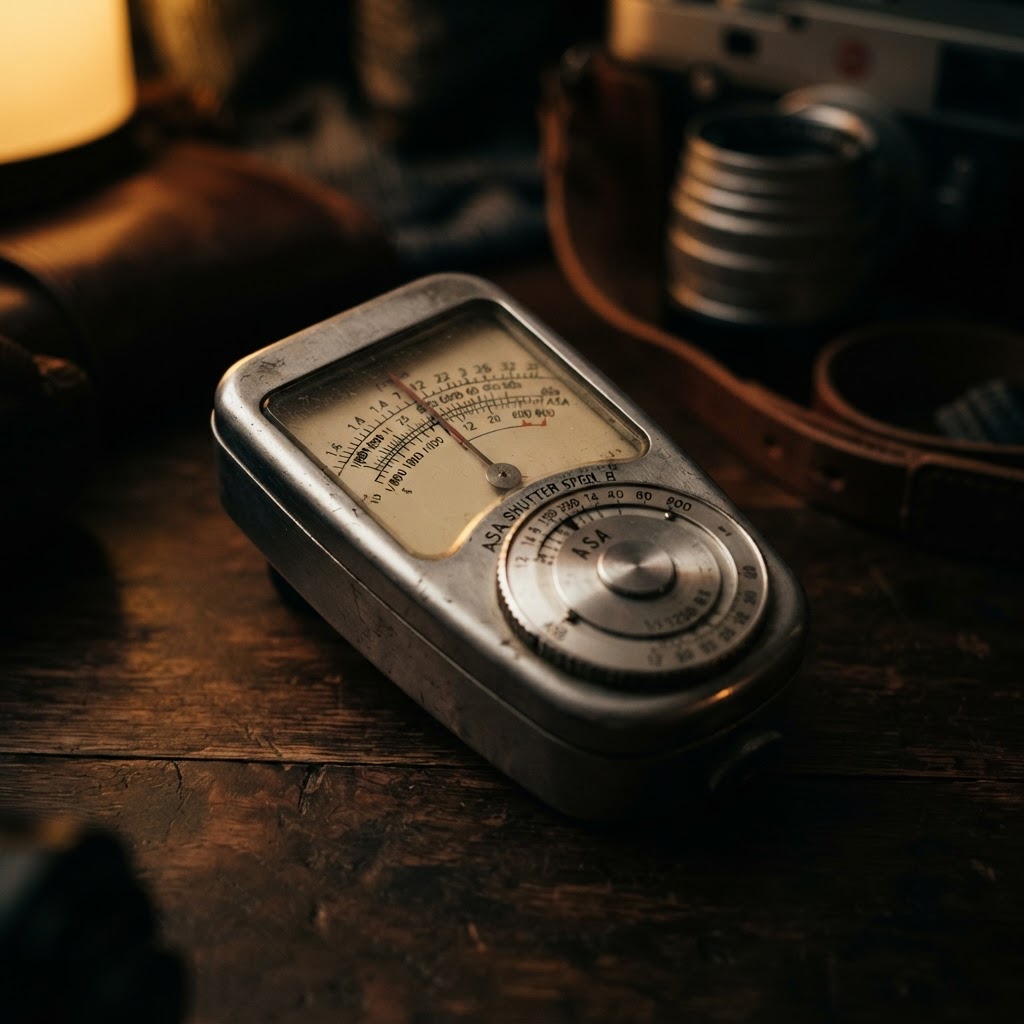
The history of the light meter is a narrative of rapid technological acceleration. While early chemical actinometers—which darkened sensitized paper as a proxy for exposure—existed in the mid-19th century, the true revolution arrived with the selenium cell. When the photoelectric effect was harnessed, it allowed for the instantaneous conversion of light into electrical current. Devices like the iconic Weston meters became the standard, liberating the photographer from the guesswork of the past. These tools provided a needle-based readout, giving the artist a definitive f-stop and shutter speed combination that would reliably render the scene as intended.
Technical Mechanics: Incident vs. Reflective
To master the light meter is to understand the two fundamental ways we read a scene:
- Reflective Reading: The meter measures the light bouncing off your subject. While intuitive, it is prone to error; a bright white wall will trick the meter into thinking the scene is brighter than it is, resulting in underexposure.
- Incident Reading: This is the professional standard. By pointing the meter from the subject back toward the camera, you measure the light actually falling upon the scene, independent of the subject’s own reflectance.
To meter effectively is to strip away the illusion of the scene and see it in its raw, tonal values—a practice that turns the photographer into a choreographer of shadow and highlight.
The Digital Hand-Off
In our modern era, where our sensors are equipped with sophisticated internal matrix metering, one might ask: is the handheld light meter obsolete? I argue that it is more relevant than ever. Relying on an in-camera meter forces you to be a reactive photographer, letting the machine decide the tonality. Utilizing a handheld meter forces you to be proactive. It demands that you physically walk to your subject, touch the space where they stand, and determine the light's quality with intent. It is the difference between letting the light dictate your work and commanding the light to follow your vision.
Mastering the Invisible
The evolution of the light meter is a testament to our desire to capture the world with absolute fidelity. As practitioners at Photography in the Raw, we must look past the convenience of automated histograms and return to the roots of measurement. When you hold a light meter, you are holding the history of precision. You are acknowledging that light is not just a medium to be captured, but a physical force that can—and must—be measured, understood, and ultimately, mastered.