Deciphering the F-Stop: A Journey Into Optical Geometry
The Anatomy of Light
In the quiet corners of our studio at Salt Media, we often talk about light as if it were a physical weight—a medium to be sculpted, measured, and finally contained. Among all the tools at our disposal, the f-stop stands as the most critical intersection of mathematics and artistic intent. While it has become second nature for many photographers to simply rotate a dial, the history of the f-stop is a fascinating descent into the evolution of optical physics.
The Etymology of Precision
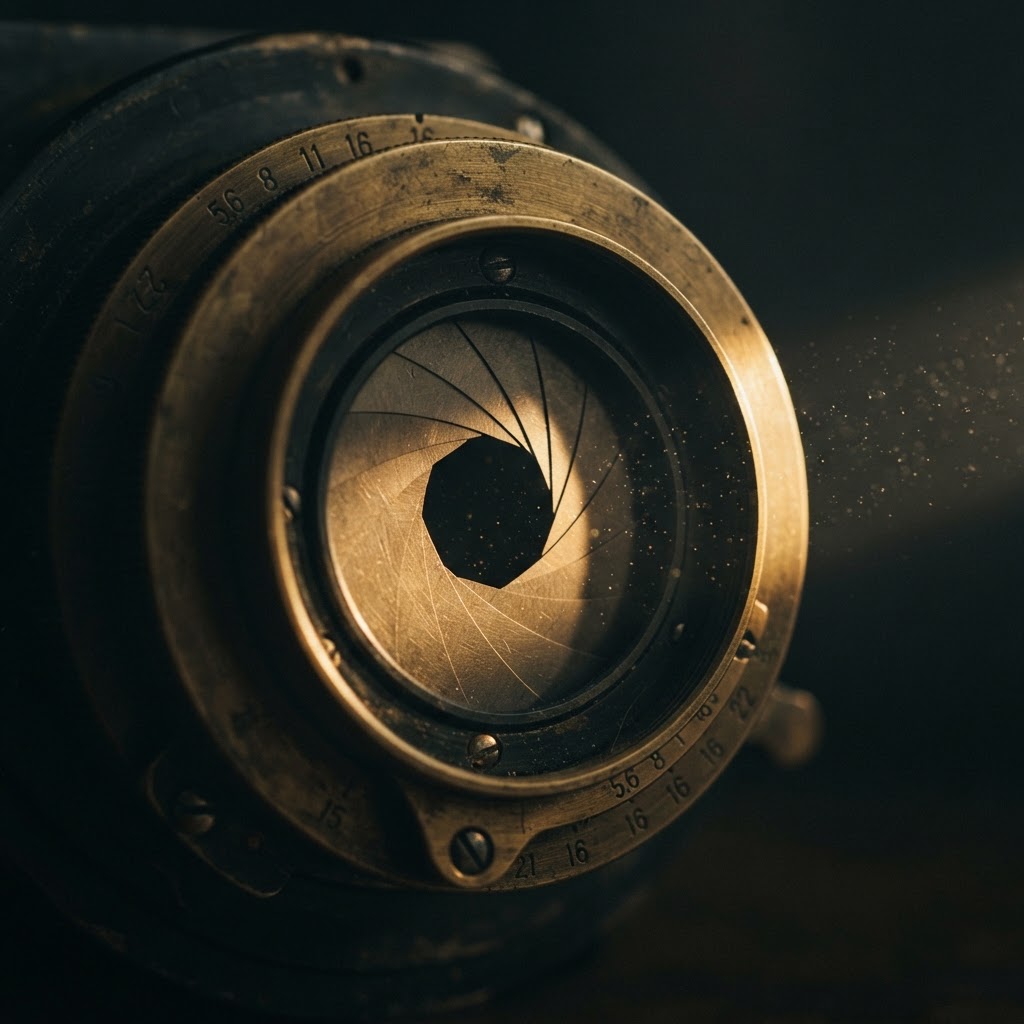
To understand the f-stop, one must first look at the letter 'f'. It is not merely a label, but a variable in a profound mathematical ratio. It represents the focal length of the lens divided by the diameter of the aperture opening. When the Royal Photographic Society began standardizing nomenclature in the late 19th century, this notation allowed photographers to achieve consistent exposure across vastly different lens designs. It transformed photography from an alchemical experiment into a predictable, repeatable science.
The f-stop is the pulse of the photograph. It regulates the flow of reality into the sensor or the emulsion, deciding exactly how much of the world is granted entry into the frame.
A Historical Shift: From Variable to Standard
Before the standardization of the f-stop scale, early practitioners were forced to calculate exposure based on a bewildering array of manufacturer-specific systems. Some used sequential numbering (1, 2, 3), while others relied on simple diameter measurements. It was the brilliance of the late 19th-century optical engineers who realized that the amount of light reaching the film plane is inversely proportional to the square of the f-number. This realization birthed the doubling sequence—f/1.4, f/2, f/2.8, f/4, and so on—where each step, or 'stop,' represents a precise halving or doubling of light intensity.
The Dual Nature of the Aperture
As we explore in our workshops at Photography in the Raw, the aperture is not merely a light valve. It is the primary architect of depth of field. When you select an f-stop, you are negotiating a contract between subject and background.
- Wide apertures (f/1.4 - f/2.8): These create an intimate, ethereal separation, pushing the background into a soft, painterly blur, known in the lexicon as bokeh.
- Mid-range apertures (f/5.6 - f/8): These represent the 'sweet spot' for most lenses, offering a balance of sharpness and clarity that feels natural to the human eye.
- Narrow apertures (f/11 - f/22): These extend the focus, ideal for landscapes where every detail—from the pebble at your feet to the mountain on the horizon—demands equal clarity.
The Philosophical Weight of the F-Stop
Why does this matter to the modern artist? Because every choice is a narrative decision. To shoot wide open is to choose mystery and isolation; it is to highlight the subject by obscuring the context. To stop down to f/16 is to demand a democratic image where the entire scene holds weight and significance. At our studio, I often tell my students: do not let the camera choose your aperture. Understand the physics, yes, but let your vision dictate the math. The f-stop is not just a setting on a screen; it is the physical manifestation of your perspective on the world.