Chromatic Aberration: The Prism of Error in Photographic Optics
The Anatomy of a Spectral Defect
In the quiet, deliberate space of the studio, we often speak of light as a singular force—a tool to be sculpted and directed. Yet, light is a complex, unruly traveler. At the heart of our craft lies a fundamental struggle between the purity of our vision and the physical limitations of the glass we look through. This conflict finds its most persistent manifestation in chromatic aberration, a phenomenon that has challenged optical engineers for centuries and serves as a constant reminder of the physical laws governing our medium.
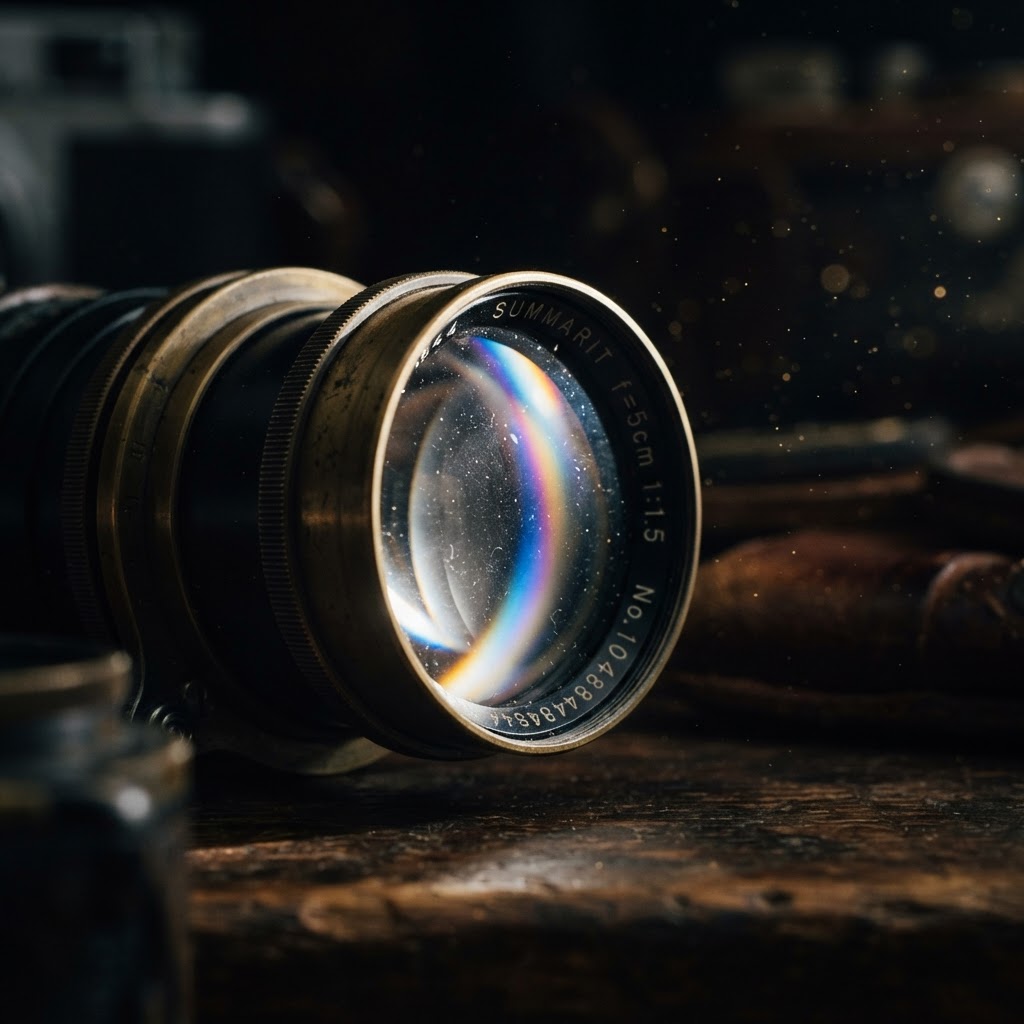
To understand chromatic aberration, one must first accept that light is not merely white; it is a symphony of colors, each traveling at a different wavelength. When these wavelengths pass through a simple glass lens, they do not converge at the exact same focal point. Violet light, with its shorter, more energetic wavelength, bends more sharply than the longer, leisurely waves of red light. The result is a failure of the lens to bring all colors to a single point of focus, creating the dreaded 'purple fringing' or ghosting that can plague high-contrast edges.
A Historical Mirage
The etymology of the term provides a roadmap to its nature: derived from the Greek chroma (color) and the Latin aberrare (to wander off). In the 17th century, the great Sir Isaac Newton inadvertently fueled the fire of this optical mystery. Convinced that it was impossible to create a lens that did not suffer from this chromatic dispersion, Newton pivoted his brilliance toward the development of the reflecting telescope. He believed that if refractive glass could not be tamed, the only path forward was to use mirrors, which reflect all wavelengths of light equally.
It was not until the 18th century, through the work of visionaries like Chester Moore Hall and John Dollond, that the 'achromatic doublet' was perfected. By combining different types of glass—crown glass and flint glass—these pioneers discovered that they could cancel out the dispersing effects of the other. It was an alchemical triumph: pairing two flawed elements to create a singular, unified clarity. This innovation effectively birth-poured the modern lens era, allowing for the corrected optics that define our professional standard today.
The Two Faces of the Fringes
In the field, we encounter two distinct forms of this phenomenon. Longitudinal (Axial) Chromatic Aberration occurs when different wavelengths focus at different distances from the lens. You will see this as magenta or green color casts appearing in the out-of-focus areas, particularly in the background of a portrait. It is the signature of a lens struggling with its own construction, often exacerbated by wide apertures.
Lateral (Transverse) Chromatic Aberration, conversely, exists in the plane of focus. Here, the colors are focused at the same distance, but their magnification varies. This manifests as color fringing that grows progressively worse as you move from the center of the frame toward the corners. Unlike axial aberration, which softens with a smaller aperture, lateral aberration is often baked into the geometry of the lens design and can only be remedied through sophisticated digital correction in post-production.
The beauty of photography is that it allows us to document reality; the irony is that our tools are constantly negotiating the physics of what is real. Chromatic aberration is simply the glass whispering its secrets about the spectrum.
Mastering the Spectrum
Modern glass elements, such as Extra-low Dispersion (ED) or Fluorite glass, have become the gold standard for mitigating these chromatic errors. By minimizing the refractive index differences between colors, manufacturers can keep the spectrum in alignment. However, even with the most expensive 'apochromatic' lenses—designed specifically to bring three wavelengths into a common focus—the potential for aberration remains if the light source is harsh and high-contrast.
As practitioners at Salt Media Studios, I encourage you to view these optical quirks not as failures, but as characteristics. While we have the digital tools to remove them in seconds, understanding where and why they occur makes you a more informed photographer. It is a lesson in humility: to know that even the most precise machinery in your kit is subject to the same laws of physics that govern a rainbow.
- Understanding the Source: Always shoot high-contrast subjects (like dark tree branches against a bright sky) to test your lens's threshold for aberration.
- The Aperture Solution: If you spot longitudinal fringing, stopping down your lens by just one or two stops will often tighten the convergence of the wavelengths.
- Post-Processing: Utilize the 'Defringe' tools in professional software, which allow you to sample the specific color of the aberration to subtract it with clinical precision.
Ultimately, photography is the art of balancing the scientific with the aesthetic. Chromatic aberration reminds us that the image we capture is an interpretation, a collaboration between the sensor, the glass, and the light itself. To master the lens is to understand its limitations, and in doing so, to transcend them.