The Art of the Bounce: Mastering Light Reflection in Photography
The Anatomy of Indirect Light
In the lexicon of the modern photographer, few techniques are as misunderstood or as profoundly transformative as the bounce flash. While the beginner often relies on the direct, forward-facing strobe that flattens subjects into two-dimensional silhouettes, the master knows that light is a fluid, reflecting medium. To bounce is to reclaim control over the physics of the environment, turning ceilings and walls into giant, soft-box reflectors. At Photography in the Raw, we teach that light is not merely emitted; it is directed, shaped, and invited to participate in the narrative of the scene.
Etymology and the Genesis of the Reflected Beam
The term bounce traces its linguistic roots to the Middle English bunsen, meaning to strike or beat. In a photographic context, the term implies an active strike against a surface, a kinetic interaction between the source and the world. Historically, the pursuit of indirect lighting was born of necessity. Early photographers struggled with the intensity of magnesium flashes—violent, singular bursts that rendered portraits with an aggressive harshness. As flash technology evolved from flammable powders to electronic capacitor systems, the goal shifted from simply obtaining an exposure to sculpting the quality of the illumination. The 'bounce' became the quiet alternative, a way to simulate the diffused quality of a cloudy sky within the confines of a dim room.
The Physics of Diffusion
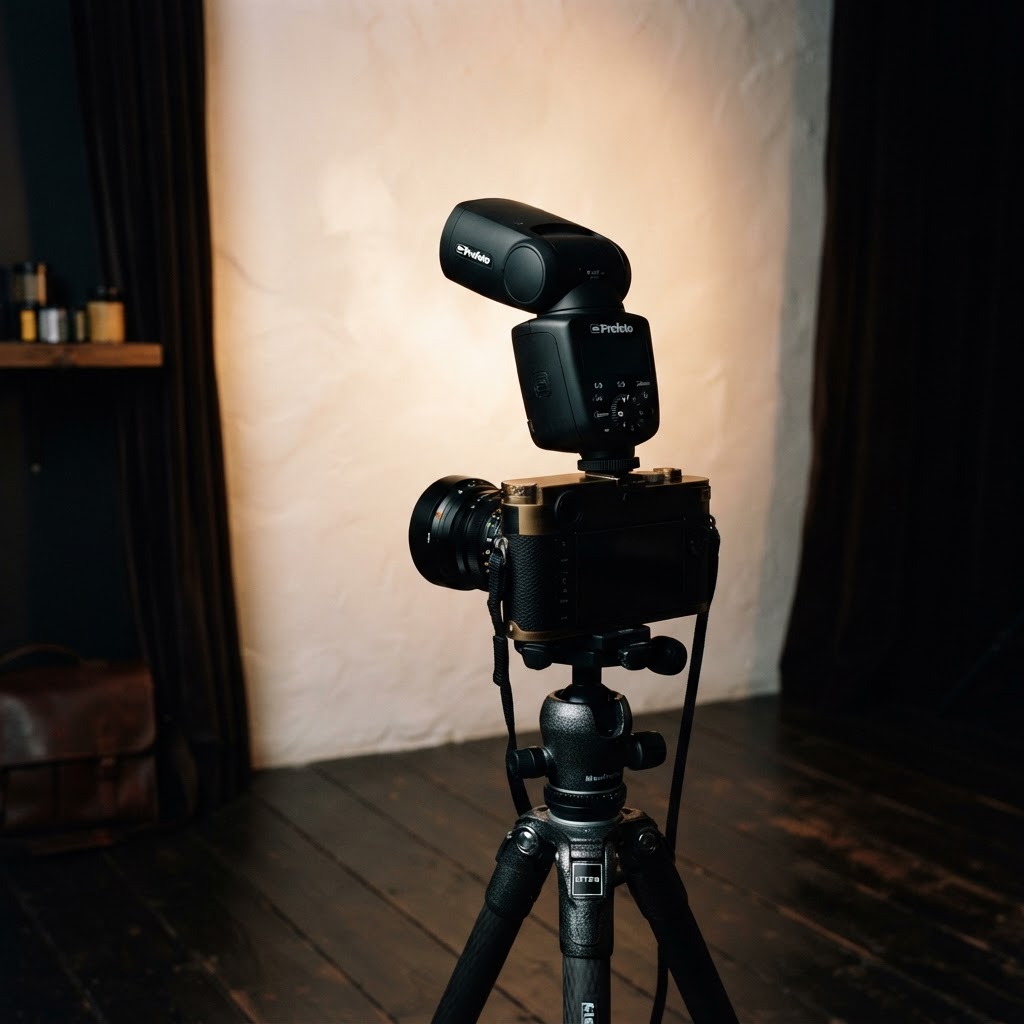
At its core, bounce flash relies on the principle of specular versus diffuse reflection. When light strikes a mirror-like surface, it reflects at an equal angle—this is the specular effect, which is rarely flattering. However, when light strikes a matte, neutral-toned surface, the photons scatter, broadening the source area significantly. This is the secret to the 'glow' found in the work of the great portraitists. By aiming a flash at a ceiling or a side wall, you effectively increase the size of the light source to match the dimensions of the reflective surface itself. A larger source yields softer shadows and a more natural transition between highlights and mid-tones, mirroring the aesthetic quality of daylight.
Technical Precision: Angles and Surfaces
Mastering the bounce is an exercise in environmental awareness. Here are the variables that dictate your success:
- Surface Reflectivity: Always observe the color of your bounce target. A green wall will bounce green light, casting a sickly hue upon your subject's skin. Neutral white or off-white surfaces are the gold standard.
- The Inverse Square Law: Remember that light loses power exponentially as it travels. If you bounce light off a high, vaulted cathedral ceiling, your effective output is reduced drastically. You must compensate with aperture or ISO, or simply recognize the limitations of your flash's power.
- The Angle of Incidence: The angle of your flash head in relation to the wall or ceiling determines the 'fill' of the shadows. Experiment with a 45-degree bounce to maintain a sense of directionality, avoiding the dreaded 'flat-face' look that occurs when the light source is too directly overhead.
To bounce light is to stop fighting the room and start collaborating with it. When you direct the flash away from the subject, you are no longer the source of the light; you are merely the architect of the environment.
The Evolution of the Technique
As we moved from the cumbersome bulky flash units of the mid-20th century to the sophisticated TTL (Through-The-Lens) metering systems of today, the bounce flash has become an essential tool for the event and wedding photographer. It allows for a speed of movement that static studio lighting cannot replicate. The modern 'bounce card' or 'diffuser cap' is but a minor evolution of this fundamental philosophy: the art of bending light to ensure that no moment is lost to the harshness of direct exposure. It is the invisible hand of the photographer, ensuring the subject is kissed by light, not struck by it.
Conclusion
Refined photography is rarely about the gear; it is about the mastery of light's behavior. By learning to bounce, you cease to be a photographer who simply captures an image and become one who crafts a mood. Next time you enter a room, look up—see the ceilings and walls not as architecture, but as your primary lighting instruments. The light is waiting; you simply have to aim it correctly.