The Daguerreotype: Silver Mirrors and the Dawn of Optical Permanence
The Silver Mirror
In the quiet corridors of photographic history, few innovations resonate with the weight of the Daguerreotype. Before pixels or film, there was the mirror—a singular, unrepeatable moment etched onto a sheet of silver-plated copper. As we explore the annals of image-making here at Photography in the Raw, we must honor the Daguerreotype not merely as an antique, but as the foundational pulse of our craft. It was the moment humanity first successfully commanded the sun to draw its own likeness.
The Etymology of Light
The term Daguerreotype is rooted in the name of its primary architect, Louis-Jacques-Mandé Daguerre. Etymologically, it represents a synthesis of person and product—a hallmark of the 19th-century propensity for naming discovery after the discoverer. Yet, the process was far from a solo endeavor. Built upon the collaborative foundations laid by Nicéphore Niépce, the Daguerreotype emerged from a world obsessed with optics, chemistry, and the desperate human desire to arrest the fleeting nature of time.
The Alchemical Process
To understand the Daguerreotype is to understand patience. The process was a rigorous, hazardous, and deeply technical ritual:
- Sensitization: A copper plate coated in highly polished silver was exposed to iodine vapors, creating a layer of light-sensitive silver iodide.
- Exposure: The plate was placed in a camera obscura, often requiring exposures lasting several minutes—a true test of a sitter's resolve.
- Development: The image was brought to life using heated mercury vapors, a process as dangerous as it was transformative, which deposited mercury atoms onto the light-exposed silver.
- Fixing: Finally, a solution of sodium thiosulfate (or 'hypo') was used to wash away the remaining light-sensitive salts, rendering the image permanent.
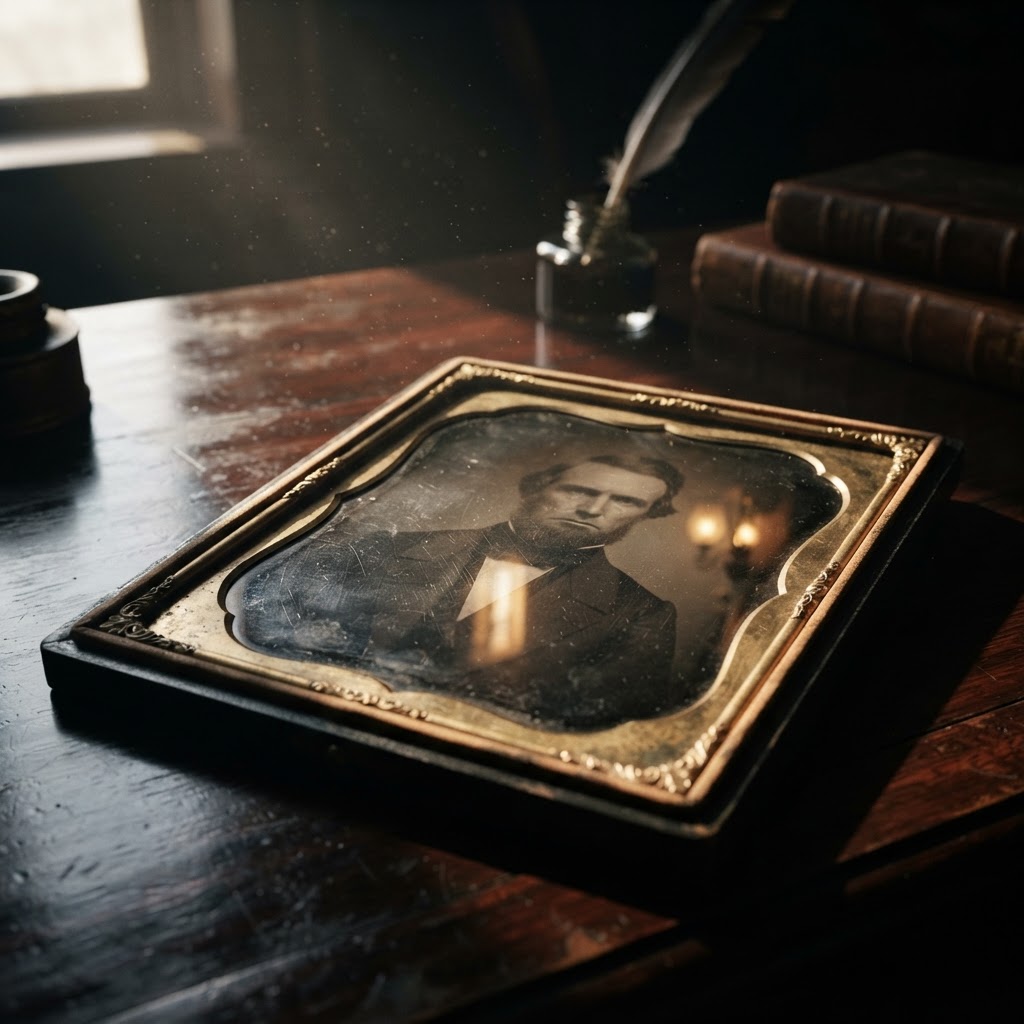
The Daguerreotype is not a print; it is a vision trapped in a metallic skin. It requires the viewer to tilt the plate against the light, catching the angle of reflection to reveal the image hidden within the darkness.
A Philosophical Shift
What truly sets the Daguerreotype apart is its physicality. Unlike the modern photograph, which relies on a negative for infinite reproduction, the Daguerreotype was a singular object. Each plate was a unique witness to its own creation. This uniqueness gave the image an aura—an almost spiritual quality—that has been lost in our age of digital abundance. For the Victorian subject, sitting for a Daguerreotype was not merely a vanity; it was a profound act of self-documentation, a way to declare one’s presence in a universe that seemed perpetually eager to forget.
Evolution and Legacy
Though the process was eventually superseded by more efficient methods, its DNA remains embedded in our photographic consciousness. The Daguerreotype taught us that light is a material—a tactile element that can be sculpted and stored. As modern photographers, we owe our understanding of long-exposure, tonal range, and archival permanence to the silver mirrors of the 1840s. Even now, when we stare into the deep blacks and brilliant highlights of a digital sensor, we are echoing the same struggle for clarity that Louis Daguerre faced in his studio.
Conclusion
At Photography in the Raw, we strive to look beyond the surface of the image. The Daguerreotype reminds us that every photograph is, at its heart, a collaboration between the artist, the subject, and the immutable laws of light. It remains the golden standard of photographic intent, proving that even in the most rigid of mediums, there exists a profound capacity for soul.